
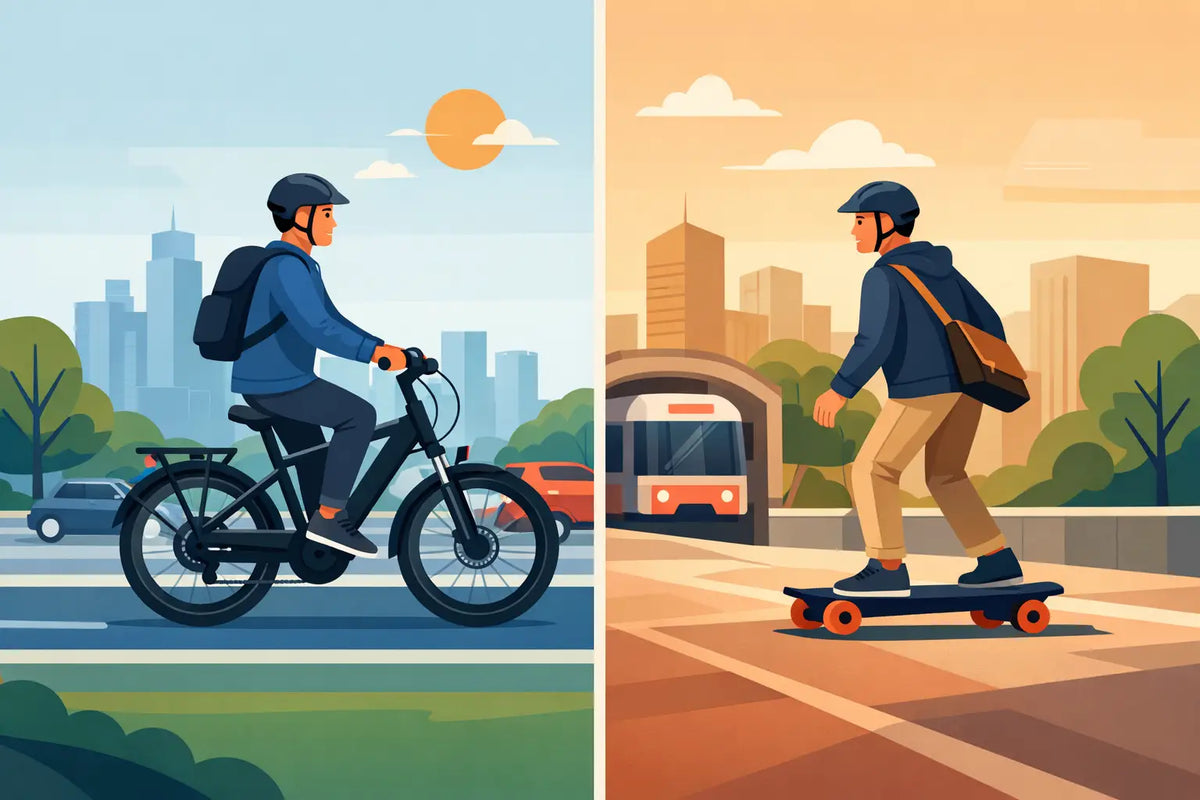
A commute is not a weekend ride. It has a start time, a destination, traffic, rough pavement, changing weather, and usually a bag on your back. The electric bike vs eskate commute decision comes down to more than top speed or advertised range. It is about which machine fits the route you ride five days a week - and which one you will still want to use after the novelty wears off.
For some riders, an electric bike is the clear utility tool: stable, practical, capable of carrying gear, and easier to use when conditions get ugly. For others, an electric skateboard delivers the better city experience: compact, fast through dense streets, easy to bring inside, and far more connected to the road. Neither is automatically the smarter choice. Your route decides.
Electric Bike vs Eskate Commute: The Real Difference
An e-bike reduces the physical effort of cycling while giving you a seated, pedal-assisted platform. Most commuter-oriented models favor predictable handling, cargo capacity, and comfortable distance. You can pedal when battery is low, mount racks or panniers, and cover rough pavement without every crack demanding your attention.
An eskate is a standing platform controlled by a handheld remote. On a quality board, the sensation is direct and athletic: you accelerate, carve, brake, and read the street with your full body. It takes less physical space than a bike and can be carried into an apartment, office, classroom, or coffee shop. That matters when secure parking is limited or bike theft is a real concern.
The trade-off is simple. An e-bike asks less of your balance and road-reading skills. An electric skateboard asks more from the rider, then pays that attention back with a lighter, more agile commute.
Route Length and Range Matter More Than Marketing Numbers
For a short urban trip of two to six miles each way, either platform can work extremely well. At that distance, storage, traffic, and riding enjoyment usually matter more than maximum range. An eskate can be the faster door-to-door option because it avoids bike racks, parking searches, and the hassle of locking up.
As daily distance climbs beyond roughly 10 to 15 miles each way, an e-bike becomes easier to justify. The seated position reduces fatigue, pedal assist gives you a backup plan, and larger frames often carry more battery capacity. Longer rides also expose you to more rough pavement, more weather, and more time sharing space with vehicles. The e-bike's stability starts to carry real value.
Do not choose based on a claimed maximum range alone. Rider weight, hills, wind, tire type, temperature, acceleration habits, and battery age all affect real-world results. For an eskate commute, leave a meaningful battery reserve rather than arriving home at 1 percent. Regenerative braking can return some energy on descents, but it is not a substitute for properly planning your route.
Hills Change the Equation
Moderate hills are not a problem for a capable e-bike or a performance electric skateboard. Steep, sustained grades are where drivetrain, motor power, gearing, and battery capacity become more than spec-sheet numbers.
An e-bike lets you contribute pedal power when the climb drags on. A powerful dual-motor or all-terrain eskate can attack a hill with authority, but your stance, traction, and braking confidence on the descent matter just as much. If your route includes long, steep hills and uneven pavement, test the route before making it your daily routine.
Storage, Security, and the Last 100 Feet
This is where eskate can win decisively. A board can come with you. You can carry it upstairs, roll it beside your desk, or place it under a worktable if the space allows. There is no outdoor lock to cut, no exposed battery, and no concern that an expensive frame will be left in a public rack all day.
That convenience is especially valuable for apartment dwellers and office commuters. A premium board is still a substantial object, and heavier high-performance models are not something you want to carry up six flights every morning. But the option exists. With a bike, the final 100 feet usually involve a rack, a lock, and a little uncertainty.
E-bikes have their own storage advantage: they can carry your gear. A backpack works on either platform for a laptop, lunch, and a light jacket. Add groceries, work boots, a change of clothes, or a child seat, and the e-bike becomes the practical heavyweight. If cargo is part of your normal day, do not force an eskate to solve a bike problem.
Ride Quality: Standing Freedom vs Seated Stability
An electric skateboard makes a familiar street feel different. Carving through a quiet bike lane, taking a clean line around broken pavement, and controlling acceleration with a precise remote can make commuting feel like riding rather than simply traveling. That is a major reason serious riders choose eskate.
The performance comes with responsibility. You need to scan farther ahead, manage your speed around pedestrians, respect wet leaves and metal plates, and brake earlier than you would in a car. Small wheels react more sharply to cracks and debris; larger pneumatic setups provide more cushion and confidence on rougher routes, though they also demand attention to tire pressure and maintenance.
E-bikes are less demanding in this respect. Larger wheels, a saddle, and a wider contact patch create a calmer platform over potholes and bad asphalt. You can look over your shoulder, signal, and navigate crowded intersections with less body fatigue. For riders new to personal electric mobility, that stability can shorten the learning curve significantly.
Weather Is Not a Minor Detail
Dry pavement favors both machines. Rain changes the answer.
For regular wet-weather commuting, an e-bike is generally the stronger choice. You still need good tires, visible lights, and disciplined braking, but a seated posture and larger tires offer more margin when surfaces are slick. Fenders also make a real difference when the streets are wet.
Eskate riders should treat rain with respect. Water can reduce grip instantly, obscure hazards, and complicate braking. Even when a board has weather-resistant construction, that does not mean every wet ride is wise. Salt, deep puddles, slick paint, and standing water are hard on equipment and harder on traction. If your city has frequent rain and you cannot shift your schedule, an e-bike offers more dependable all-season utility.
Cost Is About Ownership, Not Just Checkout Price
A low-priced e-bike or electric skateboard can look appealing until the first component failure, weak battery performance, or unavailable replacement part. A daily commuter needs a machine supported beyond the initial sale.
E-bikes may require chain care, brake adjustments, tire replacements, drivetrain service, and occasional shop labor. Those costs are manageable, but they are real. Eskates eliminate chains and pedals, yet they still need tire or wheel service, belts or driveline components depending on the setup, bearings, hardware checks, and battery-conscious charging habits.
The best ownership experience comes from choosing a platform with a real parts ecosystem. ONSRA riders, for example, can source the wear items and riding essentials that keep a performance setup working instead of treating the board as disposable hardware. The same principle applies to any e-bike purchase: confirm that batteries, brakes, tires, and service support will exist when you need them.
Choose an E-Bike If Your Commute Needs Utility
An e-bike is the better match if your route is long, you regularly carry more than a backpack, or you need to ride through inconsistent weather. It is also the more forgiving option for riders who prioritize stability over a board-sport feel. A bike can replace more car trips because it handles errands, cargo, and longer distances with less compromise.
Choose carefully, though. A heavy e-bike is difficult to carry upstairs, takes up real floor space, and can be a theft target. Check whether your workplace has secure indoor parking or a reliable rack before committing.
Choose Eskate If Your Commute Needs Agility
An electric skateboard is the right move when your commute is urban, relatively short, and dry enough to ride consistently. It excels for riders who need to bring their vehicle indoors, move through compact city spaces, and want the commute itself to be a performance experience.
It is not the lazy option. The right eskate commuter is willing to wear a helmet, use lights, inspect the board, learn controlled braking, and choose speed based on surface conditions. That discipline is what turns a fast board into a reliable transportation tool.
Before you buy either platform, ride your actual route at the time you normally commute. Notice the road texture, hills, bike lanes, intersections, parking situation, and places where rainwater collects. The best machine is not the one that looks strongest on paper. It is the one that makes you want to leave the car behind tomorrow morning.
Best Eskate Wheels for Comfort That Actually Work
Electric Skateboard Remote Replacement Guide