
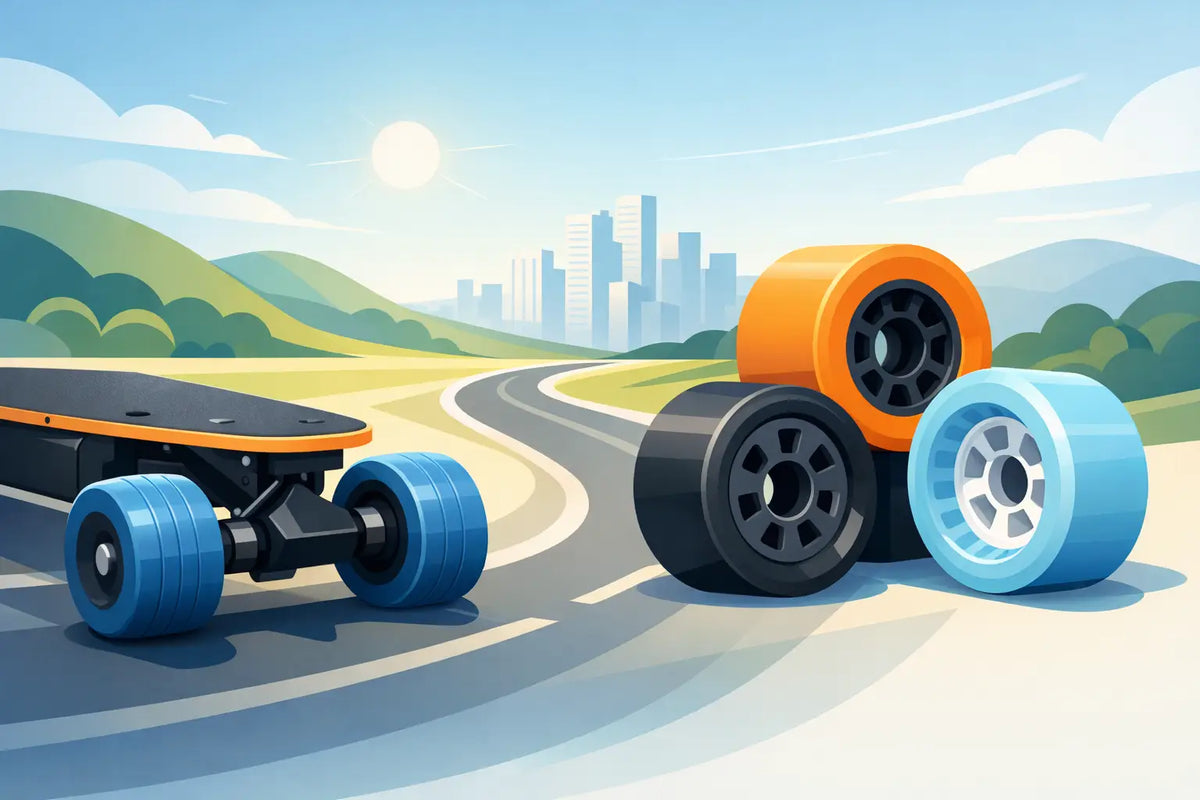
A rough street does not care how much torque your board makes. Cracked pavement, expansion joints, brick paths, and worn asphalt all hit your feet first. The best eskate wheels for comfort are the ones that reduce those impacts without turning a responsive electric skateboard into a vague, heavy setup that drains range and dulls carving.
For most riders, comfort comes down to more than wheel softness. Diameter, contact patch, construction, tire pressure, deck flex, and even your riding stance all change the result. Start with the surface you actually ride, then choose a wheel setup that gives you control when the pavement gets ugly.
What Makes Eskate Wheels Comfortable?
Comfortable wheels absorb vibration before it reaches your deck and legs. Larger wheels roll over obstacles more easily because they meet cracks and debris at a gentler angle. Softer materials deform around rough surfaces instead of transmitting every sharp edge into the board.
That is why a large street wheel can feel dramatically better than a smaller hard urethane wheel, even when both are high-quality. It is also why pneumatic tires remain the benchmark for broken pavement, gravel connectors, and mixed-surface riding. They have a true air cushion between the road and the rider.
There is always a trade-off. More comfort usually means more rotating mass, less direct road feedback, and potentially lower range. The goal is not to fit the biggest, softest wheel possible. It is to use enough wheel for your terrain while keeping the board stable, efficient, and predictable.
Diameter Changes More Than Ride Height
Wheel diameter is the first specification to consider. A 90 mm wheel is quick and agile, but it cannot erase a rough commute. Moving into the 105 mm to 120 mm range makes a noticeable difference on average city pavement. The wheel rolls over seams and small debris with less sudden deceleration, which reduces both fatigue and the chance of getting pitched forward.
For truly uneven routes, 150 mm to 175 mm pneumatic tires create a different class of ride quality. They flatten small bumps, take the sting out of broken asphalt, and maintain traction on surfaces that would overwhelm street wheels. The compromise is a taller ride height and a board that requires more power to accelerate.
Do not assume bigger is automatically safer. A wheel that creates insufficient deck clearance, causes wheelbite, or alters your gearing beyond what the drivetrain can handle is not an upgrade. Check clearance, pulley fitment, belt length, motor clearance, and enclosure geometry before changing sizes.
Soft Urethane Feels Fast, but Air Feels Forgiving
Street wheels are usually made from polyurethane. In general, a lower durometer rating means a softer wheel, but the number alone does not tell the whole story. Formula, core design, width, and lip shape all affect how a wheel rides. A quality soft urethane wheel grips well, smooths fine road vibration, and retains the direct carving feel many street riders prefer.
Pneumatic tires use an inflatable tube or tubeless air chamber. That air volume is the reason they win on comfort. Instead of relying only on material flex, the tire can compress over a sharp edge. On poor roads, that extra compliance improves traction as well as comfort because the contact patch stays connected to the ground.
The downside is maintenance. Pneumatics can puncture, lose pressure, and need occasional tire or tube service. They also introduce more rolling resistance. If your daily route is mostly clean asphalt with a few cracks, large soft urethane is often the smarter performance choice. If your route includes neglected pavement, hard-packed paths, or frequent debris, pneumatic tires earn their weight.
Best Eskate Wheels for Comfort by Riding Surface
The right category becomes clearer when you stop shopping by appearance and start shopping by terrain.
For smooth bike lanes and maintained urban streets, 105 mm to 120 mm soft urethane wheels are the comfort sweet spot. They preserve a low, connected ride while doing a much better job over seams and coarse pavement than smaller wheels. Riders who carve aggressively will usually prefer this setup over pneumatics because it feels more immediate underfoot.
For mixed commuting, where smooth roads turn into patched asphalt, driveway lips, and occasional rough side streets, large rubber street wheels or compact pneumatic tires make sense. Rubber adds damping and grip, while a smaller pneumatic setup gives meaningful cushioning without the full bulk of an all-terrain tire.
For rough pavement, park connectors, cracked industrial roads, and packed dirt, choose 150 mm or larger pneumatic tires. This is where comfort becomes a safety feature. A tire that can roll through a surface irregularity keeps your board settled and gives you more time to react.
For gravel, grass, loose dirt, or trail-focused riding, use purpose-built all-terrain pneumatic tires with an appropriate tread pattern. Comfort is only part of the equation here. You need traction, sidewall support, and stable braking under changing grip conditions.
Pressure Is Your Fastest Comfort Adjustment
Tire pressure has a major effect on how an electric skateboard feels. High pressure reduces rolling resistance and can sharpen handling, but it also makes a pneumatic setup feel nervous and harsh. Lower pressure increases grip and vibration damping, yet too little pressure can make the board feel unstable, reduce efficiency, and raise the risk of pinch flats or tire damage.
There is no universal pressure number because rider weight, tire volume, terrain, and riding speed all matter. Start within the tire manufacturer's recommended range, then make small adjustments. If the board skips across rough patches or transmits sharp chatter, lower the pressure gradually. If steering feels delayed, the tire rolls excessively in turns, or acceleration feels sluggish, add a small amount back.
Test one change at a time on the same route. A five-minute ride over familiar pavement tells you more than a spec sheet ever will.
Do Not Ignore Width, Tread, and Wheel Profile
A wider wheel generally creates a larger contact patch, which can improve stability and comfort. More material under the rider helps filter vibration, while additional grip makes rough corners less stressful. But wider is not always better for every rider. Very wide wheels can make a board feel slower to transition from edge to edge and may increase drivetrain load.
Wheel profile matters as well. Rounded lips usually feel lively and make carving easier. Squarer lips provide more grip and stability, especially under hard acceleration or braking. For comfort-focused commuting, prioritize a predictable profile over an ultra-aggressive race-oriented shape. You want the board to track cleanly when the road surface is not clean.
Tread is mostly relevant for pneumatic tires. Smooth or lightly patterned tires are efficient on pavement. Deeper tread helps on loose surfaces but can add noise, resistance, and vibration on the street. Match the tread to where you spend most of your time, not the one trail you ride once a month.
Compatibility Can Make or Break the Upgrade
A wheel upgrade changes your board's mechanical behavior. Larger diameter effectively raises the gearing, which can improve top-speed potential but reduce low-end torque and braking force. On a powerful board, that may be acceptable. On a lower-powered setup or a steep commute, it can make starts and hill climbs feel noticeably weaker.
You also need the correct wheel core or hub interface, pulley compatibility, bearing fitment, and clearance around the deck and drivetrain. Belt-driven systems are often more adaptable than hub-drive setups, but neither should be modified by guesswork. A comfortable wheel that rubs the deck at full turn is a serious problem.
This is where a complete riding ecosystem matters. Boards and components designed around clear fitment standards make it easier to build a setup that performs as intended. ONSRA riders should still confirm the specifications of their exact board before moving to a different wheel or tire size.
Comfort Also Comes From the Rest of the Board
Wheels do the first job of absorbing rough terrain, but they are not working alone. A flexible deck can reduce high-frequency vibration, while a stiff deck provides better precision at speed. Softer bushings can help the trucks react to uneven pavement, though going too soft can create instability. Properly adjusted trucks, quality bearings, and secure hardware all contribute to a calmer ride.
Your posture matters too. Standing locked-kneed turns every impact into a hit through your body. Keep a slight bend in your knees and let your legs absorb the road. This is especially important with street wheels, where the board gives you more feedback and less margin for error.
The best comfort setup is the one that makes you want to take the longer route home. Choose wheels for the pavement beneath you, keep the drivetrain within its intended limits, and give yourself enough grip and cushioning to ride relaxed when the road stops being perfect.
All Terrain vs Street Eskate: Which Fits You?
Electric Bike vs Eskate Commute - Which Fits?