
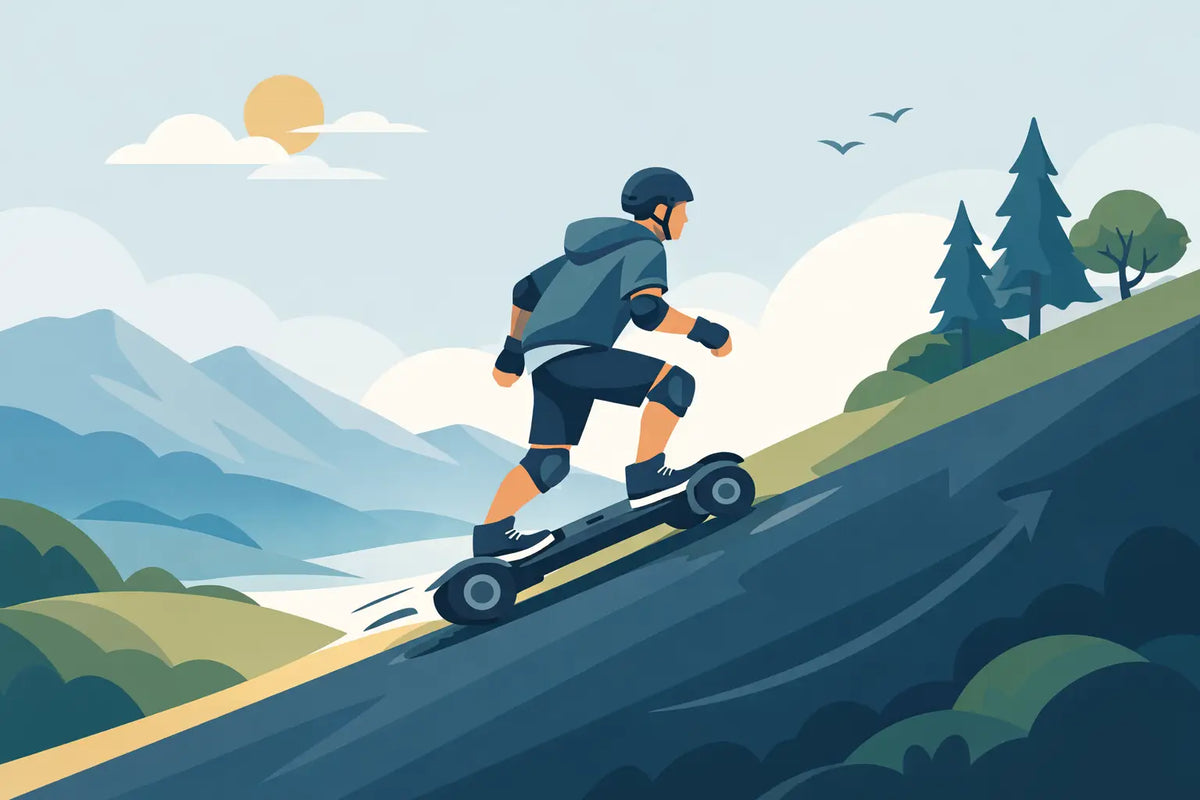
A flat-ground top-speed number tells you very little when the road points uphill. The question is not simply, “can eskates climb hills?” Most electric skateboards can handle a moderate incline. The real question is whether they can climb your hill without bogging down, overheating, draining the battery, or leaving you with too little braking control on the way back down.
For riders who commute through hilly neighborhoods, carve mountain roads, or ride mixed terrain, hill performance is one of the clearest differences between a casual e-skate and a serious performance machine. It comes down to power delivery, drivetrain setup, battery capability, traction, and how you ride.
Can Eskates Climb Hills Reliably?
Yes, but the answer depends heavily on the grade. A board that feels fast and confident on level pavement can struggle on a sustained climb. Hills demand continuous torque rather than a short burst of acceleration, and that exposes every weak point in the system.
A gentle 5% grade is manageable for many boards. A 10% to 15% hill is where rider weight, battery charge, and motor power start to matter much more. Once grades get steeper, loose, wet, or broken pavement can turn a technically possible climb into a traction problem. At that point, the board may have enough power, but the wheels may not be able to put it down effectively.
A capable electric skateboard should climb a hill at a controlled, predictable pace. It should not require a full-throttle launch, surge unpredictably, or slow to a crawl halfway up. Consistent power is what makes uphill riding enjoyable and safe.
Torque Matters More Than Top Speed
Top speed is easy to market, but torque is what moves a rider uphill. Torque is the twisting force at the wheels, and it is what gets the board rolling from a stop and keeps it pulling when gravity pushes back.
Dual-motor setups are generally the right starting point for regular hill riding because power is shared across two driven wheels. More importantly, the motors can deliver smoother traction and more stable regenerative braking than a single-drive configuration. High-output motors paired with a controller that can sustain current under load make a major difference on long climbs.
Motor power ratings alone do not tell the complete story. A large peak-watt number can look impressive while offering little information about sustained output, controller limits, thermal management, or battery current delivery. A board needs an entire power system designed to work together. Motors, ESCs, gearing, and battery all need to support the same level of riding.
Hub-drive boards can be clean, quiet, and convenient for light urban use, but they are usually less suited to steep or repeated climbs. Belt-drive and gear-drive systems offer more flexibility to tune torque through gearing. That mechanical advantage helps a performance board pull harder at lower speeds, which is exactly where hills demand the most.
Battery Voltage Keeps the Pull Consistent
Voltage is a major part of uphill performance. Higher-voltage battery systems can maintain stronger power delivery as load increases, helping the board feel less strained during a climb. They also reduce the likelihood of voltage sag, where the battery voltage drops under heavy demand and the board loses punch.
Battery capacity matters too, but it answers a different question. Capacity, measured in watt-hours, is largely about how much energy you have available. Voltage and current capability influence how forcefully that energy can be delivered. A large battery with weak cells or limited discharge capability may offer respectable range on flat ground yet feel soft on steep hills.
Charge level changes the experience. A board has more available voltage near a full charge and typically feels strongest then. As the battery drains, hill-climbing power can taper off. Plan your route accordingly, especially if your ride includes a long climb near the end.
Cold weather also reduces battery performance. On a chilly morning, expect less range and less punch than you would get from the same board on a warm afternoon. Give the board a few minutes of moderate riding before asking for maximum output, and never charge a battery that is extremely cold.
Gearing Turns Motor Power Into Climbing Force
Gearing is one of the most overlooked parts of the hill-climbing equation. A lower gear ratio favors torque and acceleration. A taller ratio favors maximum speed. Neither is universally better, but a setup built for steep streets should prioritize usable wheel torque over a headline top-speed figure.
Pulley size, gear ratio, wheel diameter, and tire choice all affect the final result. Larger wheels cover rough pavement and roll more easily over cracks, but they effectively raise the gearing and can reduce low-speed torque if the drivetrain is not adjusted to match. Smaller wheels can feel punchier uphill, though they may be less comfortable on rough surfaces.
This is why premium boards are more than a collection of big specifications. The parts need to be matched. A thoughtfully engineered drivetrain gives the rider a predictable response at the throttle instead of forcing them to choose between weak climbing power and an overly aggressive launch.
Rider Weight, Cargo, and Hill Grade Change Everything
Every extra pound has to move uphill. A lightweight rider with a small backpack may climb a 12% grade easily on a setup that feels underpowered for a larger rider carrying work gear. There is no shame in that physics - gravity is the same for every rider.
Board weight matters as well, particularly during stop-and-go riding. A heavy board can offer excellent stability, battery capacity, and durability, but it needs adequate torque to feel lively on climbs. The total system weight includes the rider, board, helmet, protective gear, and cargo.
The hill itself is not just a number. A short, steep ramp can be easier than a long 8% climb that keeps the motors loaded for several minutes. Surface quality matters too. Smooth dry asphalt offers far more traction than polished concrete, loose gravel, wet leaves, or dusty pavement.
Tires and Traction Decide Whether Power Reaches the Road
If the rear wheels spin, the board is no longer climbing efficiently. Tire compound, contact patch, pressure, and surface condition determine how well the drivetrain can transfer torque to the ground.
Pneumatic tires are often the better choice for riders who deal with rough roads, uneven pavement, or variable terrain. Their larger volume and compliant ride can improve grip while reducing the impact harshness that makes a climb tiring. They also add confidence when the descent is rough. Street wheels can be quick and precise on clean pavement, but they offer less margin when the road surface gets unpredictable.
Avoid running tires excessively hard if traction is already limited. Follow the tire manufacturer’s pressure guidance, then make sensible adjustments for rider weight and conditions. Do not chase grip by underinflating to an unsafe level. A damaged tire or unstable handling is not a worthwhile trade.
Downhill Braking Is Part of Hill Capability
A board that can climb confidently also needs to come back down under control. Most electric skateboards use regenerative braking, which sends energy back toward the battery as you slow down. That is useful, but it has a critical limitation: a fully charged battery cannot accept much regenerated energy.
Starting at the top of a steep descent with a 100% battery can reduce available braking or cause the system to limit regen to protect the pack. The practical move is simple: do not charge to full immediately before a route that begins with a major downhill. Leave a buffer when your route requires it.
Brake gradually and early rather than waiting until you are carrying too much speed. Keep your weight low, stay centered over the board, and avoid sharp turns while braking hard. If the descent is steep, wet, or unfamiliar, walk a section rather than trying to prove what the board can do.
How to Ride Hills Without Abusing Your Board
Approach a climb with momentum, but do not attack it recklessly. Begin smoothly, keep your stance balanced, and apply throttle progressively. A sudden full-power input can break traction, especially on belt-drive or high-torque setups.
Watch for signs that the system is working too hard: a major drop in speed, repeated power cutbacks, unusually hot motors, or a hot enclosure after the climb. Stop and let the board cool if needed. Repeatedly forcing a board up a hill beyond its intended capability can shorten the life of motors, belts, bearings, tires, and battery components.
For serious terrain, choose equipment designed around sustained performance rather than flat-road speed alone. Models such as the ONSRA VELAR are aimed at riders who expect strong power delivery, stable geometry, and the component durability needed for demanding routes.
The best hill-climbing board is not necessarily the fastest one on paper. It is the one that matches your weight, terrain, riding style, and route with enough torque and battery headroom to make the climb feel controlled. Before committing to a new route, ride the hill at a conservative pace, learn where traction changes, and leave enough battery for a safe trip home.
What Skateboard Durability Test Results Show
How to Replace Skateboard Bearings Correctly