
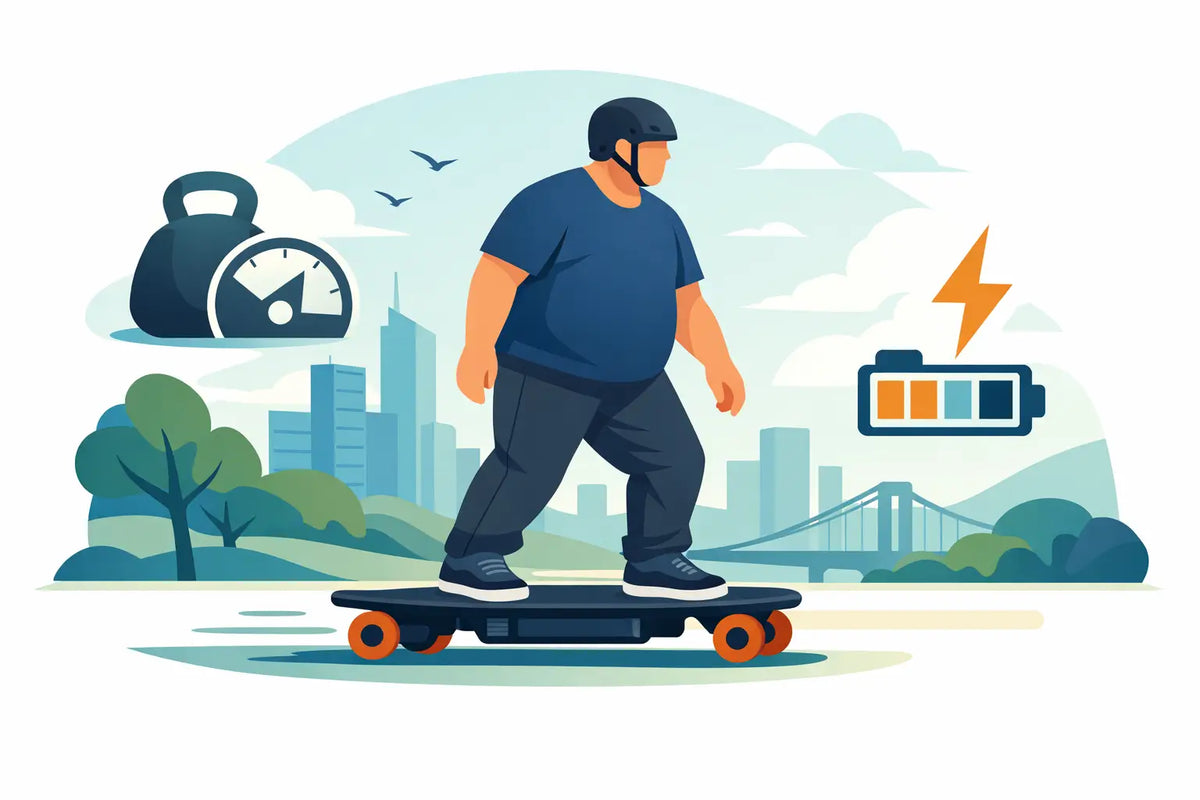
A rider’s weight changes the entire equation. On an electric longboard for heavy riders, it affects acceleration off the line, uphill speed, braking distance, deck flex, tire wear, and usable range. That does not mean bigger riders need to settle for a slow, oversized board. It means the board needs a drivetrain, chassis, and setup engineered to carry real loads with control.
The right purchase starts by looking past a single advertised top speed or range number. A board that feels strong under a 160-pound rider can feel strained under a 240-pound rider, especially on hills, rough pavement, or a commute with frequent stop-and-go traffic. Choose the platform first. Then choose the configuration that fits where and how you ride.
What Heavy Riders Need From an Electric Longboard
The most useful specification is not top speed. It is torque under load. Powerful motors, a properly matched controller, and a battery capable of delivering consistent current give a heavier rider clean acceleration rather than a delayed, struggling launch. Torque matters even more on inclines, where underpowered setups lose speed fast and force the system to work harder.
A dual-motor drivetrain is generally the right starting point for serious adult riders. It shares the work across both motors and provides more predictable traction when accelerating. Belt-drive and gear-drive systems are also worth considering because they are commonly paired with larger wheels and higher-torque performance setups. Hub-drive boards can be clean and quiet, but many prioritize a low-profile feel over the power reserve and wheel flexibility that larger riders often benefit from.
Battery capacity matters, but usable range matters more. Range figures are usually measured in favorable conditions: lighter rider, flat pavement, steady speed, mild weather, and limited acceleration. Add rider weight, hills, cold temperatures, aggressive riding, or rough roads, and the real number drops. A rider who weighs 220 pounds should treat a claimed maximum range as a best-case ceiling, not a daily guarantee.
This is why a larger battery is not simply about going farther. It gives the system more headroom. You are less likely to spend the final miles of a ride managing a weak battery, reduced performance, or a long walk home.
Start With the Board’s Weight Rating
A published rider-weight limit is the first filter, not a suggestion. Choose a board whose stated capacity comfortably exceeds your fully equipped riding weight. That means your body weight plus helmet, backpack, work gear, water, and anything else that routinely comes along.
A board rated exactly at your weight may still operate, but it gives you little margin. The deck, trucks, bushings, drivetrain, and hardware see higher loads during carving, curb transitions, braking, and uneven pavement. A healthy capacity buffer helps preserve handling and reduces the chance that the ride feels twitchy or overworked.
Look beyond the number itself. The way a deck is built matters. A quality composite, bamboo, maple, carbon fiber, or reinforced construction can each work well, depending on the intended ride style. What you want is a deck with controlled flex, not uncontrolled flex. Too stiff can become punishing over cracked streets. Too soft can feel unstable at speed, especially for a larger rider pressing hard into turns.
The truck system deserves the same attention. CNC-machined trucks, durable axles, and properly selected bushings make a noticeable difference once rider weight rises. Cheap cast components and soft stock bushings can allow excessive lean, reduce precision, and create a vague feeling in high-speed carving.
Bushings Are a Real Performance Upgrade
Heavy riders often assume a board is inherently unstable when the real issue is bushing setup. Bushings determine how readily the trucks turn and how well they return to center. Soft bushings may feel lively in a parking lot, but a heavier rider can overpower them quickly.
A firmer durometer bushing setup usually provides more support, cleaner turn-in, and better stability at speed. The goal is not to make the board difficult to steer. It is to create progressive resistance, so the board carves when you ask it to without collapsing into too much lean.
Start conservatively, particularly if you are new to electric skateboarding. A stable setup builds confidence faster than a loose setup that demands constant corrections. Once your technique improves, you can tune for deeper carves.
Braking Control Is Non-Negotiable
Heavy riders carry more momentum. That is basic physics, and it is why braking deserves as much attention as acceleration. A capable electric longboard should provide smooth, predictable regenerative braking with enough power to slow the board confidently without becoming abrupt.
The remote response and controller tuning matter here. Good braking is progressive. A light input should trim speed gradually, while a firmer input should bring meaningful deceleration. An on-off feeling at the remote makes it harder to manage pace in traffic, on bike paths, and when rolling toward an intersection.
Do not ride downhill with a fully charged battery. Regenerative braking sends energy back into the pack, and a battery at maximum charge has limited room to accept it. Depending on the board’s protection system, braking can be reduced or unavailable when you need it most. For a descent, leave charge headroom and test your braking response at low speed before committing to the hill.
Mechanical grip supports electronic braking. Bigger, softer wheels offer a larger contact patch and more compliance over broken pavement. Pneumatic tires go further, absorbing cracks, expansion joints, gravel, and uneven roads that can unsettle smaller urethane wheels. The trade-off is added weight, rolling resistance, and maintenance. Tires need pressure checks and can puncture, while urethane wheels are simpler and often more efficient on smooth pavement.
For riders dealing with rough streets, heavier body weight, or mixed terrain, that extra control is usually worth it.
Wheel Size, Tires, and Ride Comfort
Small wheels can make a board feel quick and low to the ground, but they transfer more road shock into the deck and rider. Larger wheels roll over imperfections more effectively and help retain speed through rough sections. They also give a drivetrain more leverage for practical, loaded riding.
Wheel choice depends on your surface. If your route is mostly smooth asphalt, quality large urethane wheels may offer a responsive, quiet ride with low maintenance. If your daily route includes patched roads, sidewalk seams, cobblestone sections, or debris, pneumatic tires create a much larger comfort and safety margin.
Tire pressure also affects handling. Higher pressure rolls faster and feels more direct, while lower pressure improves comfort and grip but can increase drag. Stay within the manufacturer’s recommended range. Underinflated tires can feel vague and increase pinch-flat risk, while excessive pressure sacrifices traction and impact absorption.
Range Planning for Real-World Riding
A heavier rider should buy range for the route they actually ride, not the route they hope to ride once. Think about distance, elevation, pavement quality, weather, and how often you stop. Hard launches and repeated braking use more energy than a steady cruise.
If your commute is 10 miles round trip, a board advertised at 10 miles of maximum range is not a practical fit. You need enough reserve to account for wind, hills, cold weather, battery aging, detours, and the occasional ride home after a long day. Running a battery near empty every time is not the relaxed ownership experience a premium board should deliver.
Charging also belongs in the decision. A removable battery can be useful for apartment living or office charging, while an integrated pack may offer a cleaner chassis and fewer connection points. There is no universal winner. Choose the setup that makes regular charging realistic for your routine.
Setup and Maintenance Matter More Under Load
The board is only as dependable as the setup you maintain. Heavier riders place more demand on hardware, drivetrains, bearings, belts, and tires. A quick pre-ride check is a smart habit: inspect wheel wear, confirm tire pressure if applicable, check visible hardware, and make sure the remote and board are properly charged.
Pay attention to changes in ride feel. A new vibration, clicking drivetrain, uneven tire wear, or unstable turn is worth investigating early. Small issues are easier to correct before they affect performance or cause collateral wear.
Premium ownership also means access to replacement parts and support. Wheels wear out. Belts can eventually need replacement. Bushings may need tuning. A board built around a real aftermarket ecosystem stays rideable longer than one that becomes a disposable product after a single damaged component. ONSRA’s performance-focused approach reflects that reality: serious riders need a machine they can maintain, tune, and keep pushing.
Choose Stability Before Speed
A high speed rating can be appealing, but speed without chassis control is not performance. For a heavier rider, a board with strong torque, a stable truck setup, dependable brakes, and appropriate wheels will feel faster in the real world because you can use its power with confidence.
Wear a certified helmet, add gloves and protective gear for higher-speed riding, and spend time learning the board’s braking behavior on an open, flat stretch of pavement. Build speed gradually. The best electric longboard is not the one that posts the biggest number. It is the one that stays composed when the road gets rough, the grade steepens, and your ride demands more from every component.
Eskate Battery Range Guide for Real-World Miles
How to Pick Eskate Wheels for Every Ride