
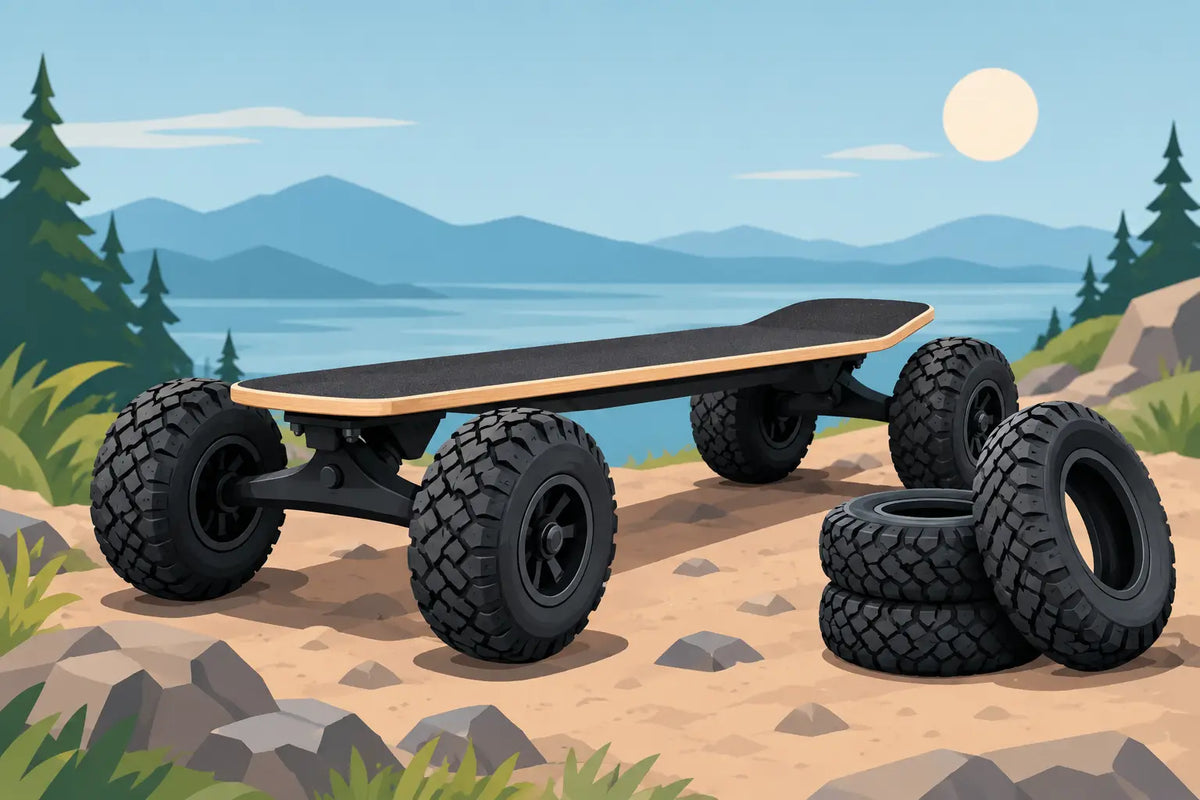
A cracked bike lane, a patch of loose gravel, wet pavement, and a hard-packed dirt shortcut can all happen in one ride. The best all terrain skateboard tires are not simply the biggest tires you can mount. They are the tires that match your board’s drivetrain, your terrain, your speed, and the level of control you expect when the surface stops being predictable.
For serious electric skateboard riders, tires are a performance component. They determine how much braking confidence you have on a downhill, how much vibration reaches your feet, how efficiently your motors work, and whether a rough route feels like a fun line or a punishment.
What Makes the Best All Terrain Skateboard Tires?
An all-terrain tire has to do several jobs at once. It needs enough volume to absorb broken pavement and trail chatter, enough tread to find traction on loose surfaces, and a casing strong enough to survive real-world abuse. But more aggressive is not always better. A deep, open tread can increase rolling resistance, make road riding louder, and reduce range compared with a smoother street-focused pattern.
The right choice depends on where you ride most. If your route is 80 percent pavement and 20 percent gravel or packed dirt, a hybrid tread usually delivers the best result. If you regularly ride dry singletrack, grass, loose trail, or construction-zone roads, a more pronounced knobby pattern earns its place. Riders who spend nearly every mile on asphalt may be better served by a street tire with a rounded profile and minimal grooves.
The best setup is not the one that looks most aggressive in a product photo. It is the one that keeps the contact patch planted at your normal riding speed.
Tire Size: Clearance, Comfort, and Torque
Pneumatic skateboard tires are commonly measured by outer diameter and width. Popular all-terrain sizes include 6-inch, 7-inch, and 8-inch options, though actual dimensions can vary between manufacturers.
A 6-inch tire is quick to accelerate, generally lighter, and easier on range. It can be a strong choice for urban riders who want some off-road capability without turning their board into a dedicated trail machine. The trade-off is a smaller air volume, which means less impact absorption and less ability to roll over deep gravel, roots, and large cracks.
A 7-inch tire is often the sweet spot for mixed terrain. It gives you a meaningful step up in comfort and obstacle clearance while staying responsive enough for carving and city riding. For many high-performance boards, this is the size that balances control, torque, and versatility most effectively.
An 8-inch tire offers maximum cushion and roll-over ability, especially on rough dirt and uneven trails. It also places a larger load on the drivetrain. Larger tires effectively raise the gearing, which can soften acceleration and braking unless the board has enough motor power and the correct pulley ratio to support them. They may also introduce clearance issues at full steering lock or under hard compression.
Before changing size, confirm deck clearance, truck clearance, belt length, wheel pulley compatibility, and whether your motors can deliver the torque your new setup demands. A tire upgrade should never create rubbing, belt misalignment, or compromised braking performance.
Tread Pattern Should Match the Surface
Tread is where many riders make the wrong call. They see deep knobs and assume more grip everywhere. On clean pavement, oversized knobs can squirm under load and reduce the precise, connected feel that makes a powerful board enjoyable to carve.
Hybrid Tread for Mixed Routes
Hybrid tires use a closely spaced center section with more defined shoulder blocks. The center rolls efficiently on pavement, while the outer tread gives you extra bite when you lean into loose corners or cross gravel. This is the practical choice for riders who commute during the week and take the long way home when the route looks interesting.
A hybrid tire also tends to be more predictable on changing surfaces. It will not turn wet leaves or loose gravel into high-grip terrain, but it provides a more controlled transition between asphalt, hardpack, and rough paths.
Knobby Tread for Loose Dirt and Trails
Knobby tires use larger, more separated tread blocks to dig into soft or loose ground. They are the better option for dry dirt, sandier trails, grass, and rocky terrain where a smooth tire would skate across the surface.
The penalty is rolling resistance. Knobbies can reduce range, add road noise, and wear faster when used primarily on pavement. If trails are a weekend activity rather than your normal riding environment, a hybrid pattern is usually the smarter year-round tire.
Street-Biased Tread for Fast Asphalt
A street-biased pneumatic tire has a smoother center profile and shallow water channels. It offers lower rolling resistance, quieter running, and more consistent lean behavior on clean roads. It is not the tire for deep loose gravel, but it can handle imperfect pavement, light dirt paths, and everyday urban debris far better than a small urethane wheel.
Compound and Carcass Matter as Much as Tread
Rubber compound determines how a tire grips, wears, and behaves across temperatures. Softer compounds generally provide more mechanical grip and a more forgiving ride, particularly on cold or uneven surfaces. They also wear faster. Harder compounds tend to last longer and roll more efficiently, but can give up confidence on wet pavement and dusty corners.
For mixed riding, a medium-soft compound is often the right call. It gives the tire enough compliance to conform to small surface irregularities without disappearing after a season of road miles.
Pay attention to the tire’s carcass as well. The carcass is the structural body beneath the tread. A stronger casing resists cuts, sidewall damage, and deformation during hard cornering. This matters on an electric skateboard because high torque and strong braking loads can stress a tire more aggressively than casual bicycle use.
If your routes include sharp gravel, thorns, or broken urban streets, prioritize puncture resistance. A heavier tire may cost a small amount of range, but walking a disabled board home costs far more ride time.
Tubes, Tubeless Systems, and Flat Prevention
Tube-type tires remain common because they are straightforward to service and compatible with many established all-terrain wheel systems. Carrying a spare tube, tire levers, and a compact pump is sensible for riders who go beyond the neighborhood.
Tubeless systems can reduce pinch flats and may seal small punctures with sealant. They can also run at lower pressures with less risk of damaging an inner tube. However, tubeless setups require compatible rims, careful installation, and regular attention to sealant condition. They are not automatically better for every board.
Whatever system you run, avoid treating tire sealant as permission to ignore damage. Inspect the tread and sidewalls after trail rides, especially if you feel a new vibration or notice pressure dropping between sessions.
Pressure Is Your Fastest Handling Upgrade
Tire pressure changes the personality of a board more quickly than most hardware swaps. Higher pressure reduces rolling resistance and can sharpen steering response, but it also makes the ride harsher and reduces the tire’s ability to conform to rough terrain. Lower pressure increases comfort and grip, yet excessive softness can make the board feel vague, increase heat, and risk rim strikes or tire burping on aggressive turns.
Start within the tire manufacturer’s stated pressure range, then adjust in small increments. Rider weight, riding speed, tire width, ambient temperature, and terrain all matter. A heavier rider or a rider hitting rough terrain at speed will usually need more pressure than a lighter rider cruising smooth paths.
Check pressure before every serious ride. Pneumatic tires lose air over time, and even a modest drop can change handling and range. Use an accurate gauge rather than judging by feel with your thumb.
Compatibility Is Non-Negotiable
A tire is only as good as the wheel, hub, pulley, and drivetrain it works with. Confirm the tire’s rim diameter, width, bead design, and intended wheel type before ordering. Also verify that the rear tire setup clears your belts, motor mounts, and enclosure under suspension-like deck flex and full steering angle.
This is particularly important when moving to larger tires. The board may physically accept them while still suffering from reduced braking authority, belt clearance problems, or a gearing setup that makes acceleration feel flat. Premium components are engineered as a system, not as isolated upgrades.
ONSRA riders should treat tire changes with the same attention given to trucks, bushings, and drivetrain maintenance. A properly matched setup preserves the board’s intended control at speed while giving you the surface capability you actually need.
Choose a tire that makes your favorite routes bigger, not one that makes every paved mile feel slower. When the pressure is set correctly and the tread matches the terrain, rough ground stops interrupting the ride and starts becoming part of it.
Is a Four Year Warranty Worth It for E-Riders?