
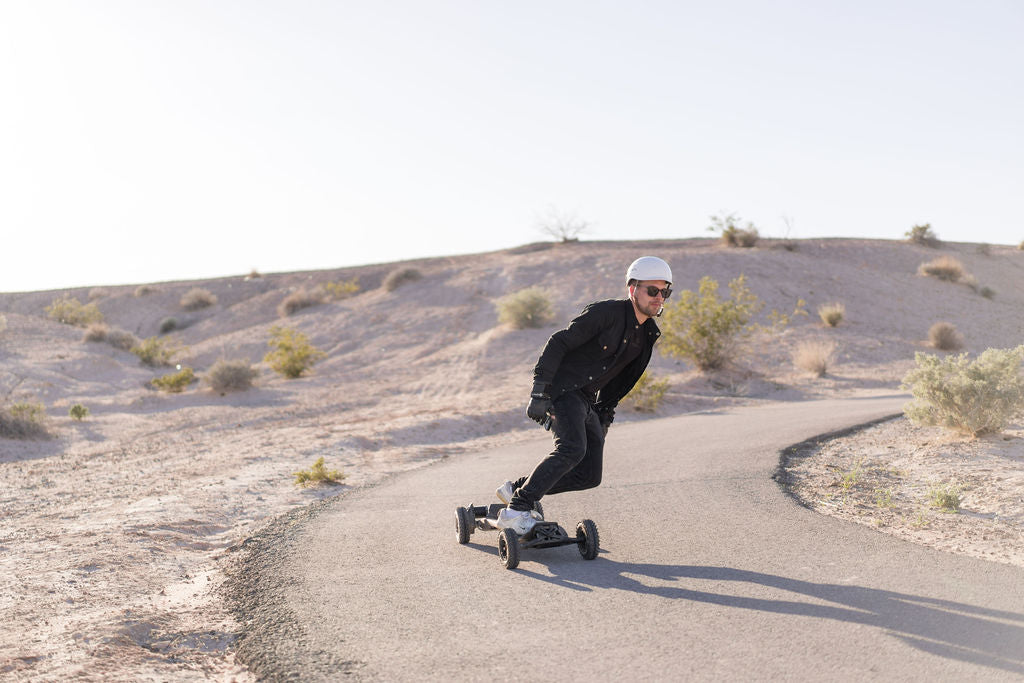
That twitchy moment mid-carve rarely comes from one big flaw. It usually comes from a setup that is slightly off, stance timing that is a beat late, and speed slightly above what the current tune supports. Improving eskate carving stability is rarely a single dramatic fix. It is a series of targeted adjustments that make the board feel planted, predictable, and confident through every turn.
Stable carving separates a premium ride from one that feels nervous. It lets you carry speed, link turns smoothly, handle rough pavement, and reduce constant micro-corrections that cause fatigue.

Start with truck geometry
Most carving issues trace back to trucks. Riders often blame deck flex or wheels first, but truck behavior dictates initiation, lean, and return to center.
A stable setup typically pairs a slightly more responsive front truck with a more supportive rear. This creates steering from the front and tracking from the back. Equally loose trucks can feel surfy at low speed but sketchy as pace builds. Deck height and width also matter: lower platforms drop your center of gravity; wider decks give better leverage for edge control at higher lean angles.
Bushings deliver the biggest gains
Stock bushings are compromises for average riders, not your weight, style, or speed. They are the highest-leverage adjustment.
- Softer bushings ease turn-in but can let the board dive or rebound unpredictably.
- Harder bushings add support and high-speed composure but can reduce playfulness.
Most riders benefit from slightly softer in front and harder in rear. Barrel bushings generally provide better support and return than cones for stability. Cup washers restrict movement for more planted feel; flat washers allow freer turning. Test small changes—durometer, shape, and washers—rather than over-relying on kingpin tension.
Kingpin tension: Use sparingly
Tightening trucks calms wobble but has limits. Overtightening kills flow, creates uneven loading, and crushes bushings into inconsistent behavior. Adjust in small increments, ride, and stop when the board feels supported without fighting you. If major tightening still leaves instability, swap bushings or rebalance front/rear instead.
Wheels, tires, and pressure
Contact patch is where confidence lives.
- Larger wheels smooth chatter and carry momentum for calmer carving on rough roads.
- Urethane formula affects grip and response: softer for comfort/grip, harder for quick transitions.
- Pneumatic tires add compliance but depend heavily on pressure. Too high = nervous and skippy. Too low = sluggish and vague under load.
Heavier riders usually need higher PSI for support; lighter riders can run slightly lower for grip. A few PSI often transforms planted feel more than truck tweaks.

Stance and technique amplify or destroy hardware potential
Even the best setup feels unstable with poor technique. Stay low, bend knees, drive from legs/hips, and apply pressure progressively. Leaning aggressively with the upper body causes abrupt overload and twitchiness. Wider stance improves leverage. Smooth timing between edges beats jerky inputs. Foot placement (front foot angled for guidance, rear stable) makes a noticeable difference in linked turns.
Speed reveals weaknesses
A board stable at 12 mph (19 km/h) can feel very different at 22+ mph (35+ km/h). Always test adjustments at your actual riding speeds on relevant surfaces. Tuning only in parking lots leads to setups that fall apart when it counts.
Rough pavement specifics
Rough roads magnify flaws. Aim for controlled compliance: enough support to hold lines, enough give to absorb chatter without deflection. On all-terrain setups, balanced tire pressure and strong rear-truck tuning help most. On street setups, wheel compound and bushing support usually lead.
Premium components (precision trucks, consistent bushings, quality drivetrain) maintain predictable behavior turn after turn because they resist wear and slop.
Build for your riding, not someone else’s settings
Stability is personal. Weight, terrain, wheel choice, and goals change the ideal tune. Copying another rider’s exact setup (especially a heavier or faster rider) is often counterproductive. The reliable process: balance trucks, match bushings to your weight/style, fine-tune tension and washers, then optimize wheels/pressure. Test iteratively at speed.
ONSRA platforms (VELAR 2.0 and Challenger 2.0 series) give more tuning headroom because of CNC-machined trucks, strong drivetrains, and wheel-swap compatibility. This lets you refine carving without the board feeling fundamentally compromised.
The best carving setup lets you lean in without second-guessing the board. When hardware and rider inputs align, carving shifts from constant correction to confident control.

Explore models built for tunable performance: onsra.com/collections/all-electric-skateboards
Spare parts and tuning components: onsra.com/collections/all-spare-parts
How to Adjust Electric Skateboard Trucks
All Terrain vs Street Eskate: Which Fits You?