
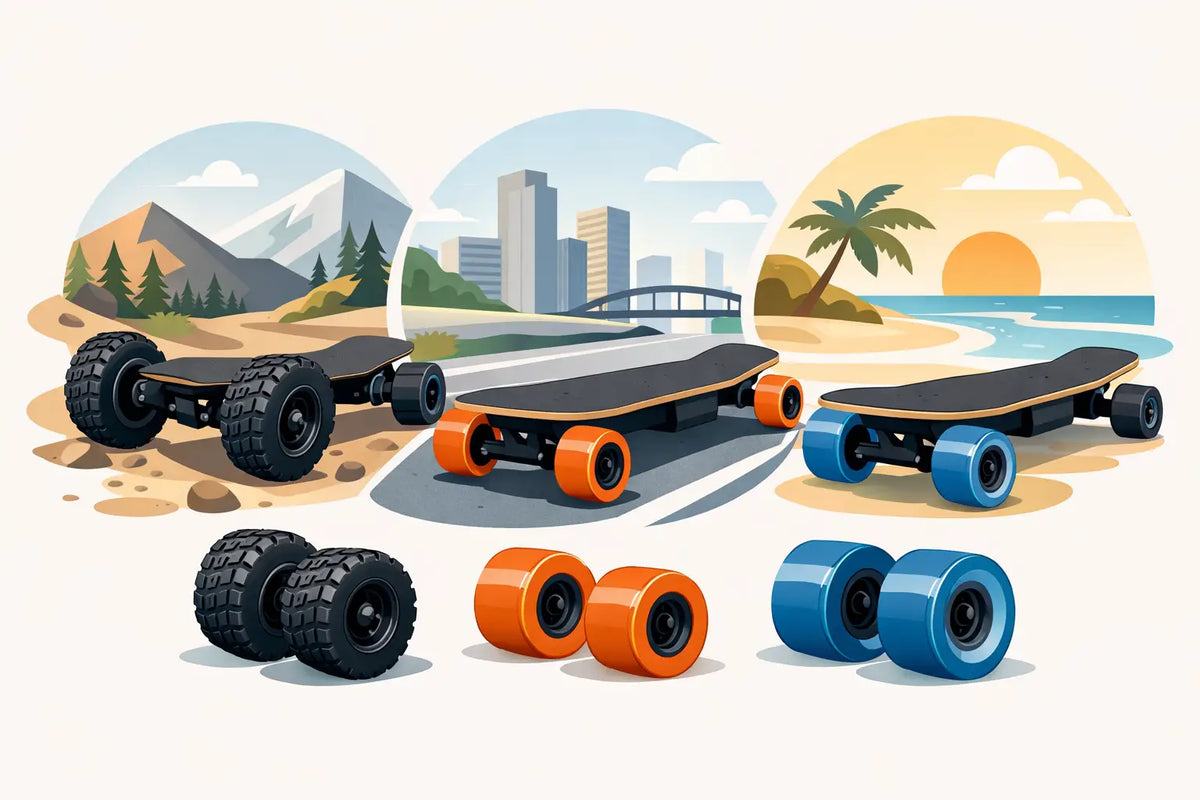
A wheel change can make the same electric skateboard feel faster, calmer, grippier, or dramatically more comfortable. That is why learning how to pick eskate wheels is not about chasing the largest diameter or softest urethane. It is about matching the wheel to your roads, your drivetrain, and the way you actually ride.
For a commuter, the right wheel may mean fewer vibrations and more confidence over rough pavement. For a performance rider, it may mean firmer edge support, controlled slides, and predictable braking at speed. Start with the conditions you ride most, then build your wheel setup around the trade-offs that matter.
How to Pick Eskate Wheels: Start With Your Surface
Your usual terrain should make the first decision for you. Smooth bike paths, cracked city streets, parking garages, and hard-packed trails all ask different things of a wheel.
On smooth pavement, a smaller or medium-size street wheel is responsive and direct. It accelerates quickly, keeps deck height lower, and gives the board a lively carving feel. If your routes are clean and you prioritize sharp turns, a quality polyurethane wheel around 90 mm to 100 mm can be a strong fit.
Rough pavement changes the equation. Expansion joints, coarse asphalt, small gravel, and sidewalk seams punish small wheels. A larger wheel rolls over obstacles more easily because its leading edge meets the obstacle at a shallower angle. Moving to 105 mm, 110 mm, or beyond can noticeably reduce vibration and improve stability, provided your board has the clearance and drivetrain support for it.
All-terrain riding is different again. Pneumatic tires provide the most compliance and grip on uneven ground, grass, packed dirt, and poor pavement. They also require more maintenance, add rotational weight, and can be more vulnerable to punctures. For riders who stay on pavement but want a smoother ride, large polyurethane wheels are often the better middle ground.
Diameter Changes More Than Comfort
Wheel diameter has a direct effect on acceleration, braking, top speed, deck height, and range behavior. Bigger wheels cover more distance per rotation, effectively making the gearing taller. That can raise potential top speed, but it reduces low-end torque at the wheel. On a hill or during hard acceleration, a large wheel may feel less aggressive than a smaller one on the same board.
The same applies to braking. Bigger wheels require more torque to slow down with the same authority. A capable dual-motor board can handle larger wheels well, but riders should still expect a different brake feel after a substantial diameter change. Give yourself time to recalibrate before riding at full speed.
Deck height matters, too. Larger wheels can raise the board, which improves clearance but also raises your center of gravity. At speed, that can make a setup feel less planted. For carving and urban commuting, a lower deck often feels more connected. For rougher streets, the extra clearance and rollover ability may be worth it.
Do not assume bigger always means more range. Larger wheels can roll efficiently on rough surfaces, but they are also heavier and may require more energy during repeated acceleration. Real-world range depends on rider weight, terrain, tire pressure when applicable, motor setup, and how often you use full throttle. Choose a wheel size for the ride quality and terrain you need first.
Durometer Determines Grip and Road Feel
Durometer is the hardness rating of a polyurethane wheel. In general, lower numbers indicate softer urethane, while higher numbers indicate harder urethane. Soft wheels absorb more vibration and grip rough pavement better. Harder wheels feel quicker and more precise on smooth ground, but they transmit more road texture through the deck.
For everyday street riding, softer formulas in the high-70A to low-80A range are popular because they provide a comfortable ride and dependable traction. On clean pavement, a harder wheel can feel more responsive and may slide more predictably. That can be appealing for experienced riders, but less grip leaves a smaller margin for error during hard braking or aggressive cornering.
Durometer numbers are useful, but they are not the entire story. Urethane formulas vary by manufacturer. Two wheels with the same printed durometer can have noticeably different rebound, grip, wear resistance, and feel. A premium wheel is not only about how hard it is. The quality of the compound, the core design, and the way the wheel holds its shape under load all affect performance.
If your routes include rough asphalt, damp patches, painted lines, or debris, favor grip and comfort over a harder, faster-feeling setup. A controlled ride is always faster than one that makes you back off the throttle.
Width, Profile, and Core Shape Control Carving
A wheel's width and lip profile determine how much urethane contacts the ground and how the wheel behaves under side load. A wider contact patch generally adds stability and grip, especially when accelerating, braking, and carving at speed. It can also make a board feel more deliberate when initiating turns.
Rounded lips tend to transition into slides more smoothly and feel less locked into the pavement. Square lips offer stronger edge grip and a more planted feel. Neither is automatically better. Riders who want deep carves and high-speed confidence often prefer a supportive, grippy profile. Riders who enjoy freeride-style movement may prefer a more rounded shape.
Pay attention to the wheel core as well. A stiff, well-supported core keeps the wheel stable under hard cornering and high motor torque. Weak cores can flex excessively, create vague handling, or fail over time. On a powerful electric skateboard, the core is a structural component, not just a place to mount a pulley.
Confirm Compatibility Before You Buy
The best wheel on paper is useless if it does not fit your setup. Before changing wheels, confirm wheel clearance, axle width, bearing size, pulley compatibility, belt length, and motor mount clearance. Some wheels require specific pulleys or adapters. Others have a core shape that does not work with your current drivetrain.
Most street-wheel systems use standard skateboard bearings, but not every wheel, hub, or tire setup follows the same format. Hub-drive boards require model-specific sleeves or wheel assemblies. Belt-drive boards offer more wheel options, though the pulley and belt relationship still needs to be correct. Gear-drive boards may use proprietary interfaces that limit compatible wheel choices.
Check for physical clearance with the deck, truck hangers, enclosures, and motors. Larger wheels can rub under compression or during sharp turns even if they appear to fit while the board is standing still. After installation, spin each wheel freely and inspect it through the full steering range.
If you move to a significantly larger diameter, confirm whether your remote or controller has a wheel-size setting. Accurate wheel diameter settings help the display calculate speed and distance more reliably. They do not change the mechanical gearing, but they prevent misleading ride data.
Choose Wheels for the Riding You Do Most
It is easy to build a setup around the one rough road or smooth path that appears on your route. Resist that temptation. Pick wheels for the conditions that make up most of your miles.
A rider commuting through uneven city streets should prioritize comfort, durability, and stable braking. A rider with smooth pavement and a carving-focused setup can prioritize lower deck height, responsiveness, and a grippy profile. A rider who regularly encounters dirt paths or seriously broken pavement may be better served by a purpose-built all-terrain system instead of forcing street wheels to do a job they were never designed for.
Rider weight and riding style also matter. Heavier riders load urethane harder during turns and braking, so they may benefit from a wider, more supportive wheel. Aggressive riders who accelerate hard and carve at speed should favor wheels with a proven core and predictable grip. Casual riders may value comfort above all else.
Know When Your Current Wheels Are Done
Wheels wear gradually, which makes it easy to miss how much performance has disappeared. Look for coning, flat spots, chunks missing from the lip, cracks around the core, or uneven wear between the front and rear. Rear wheels often wear faster because they handle motor torque and regenerative braking.
Rotate wheels when practical to extend usable life and maintain a more balanced feel. Replace any wheel with structural damage immediately. A cracked core or severely chunked wheel can compromise handling when you need consistency most.
For riders building a premium street setup, wheels should be treated as a performance component, not a cosmetic upgrade. ONSRA riders who match wheel size and compound to their board's power, terrain, and drivetrain get more from every mile without sacrificing the confidence that makes high-performance riding fun.
Choose the wheel that gives you more control on the roads you ride every week. The right setup should make you want to carve longer, brake later with confidence, and take the route home that is not perfectly paved.
Choosing an Electric Longboard for Heavy Riders
How to Replace Eskate Belts Without Losing Power