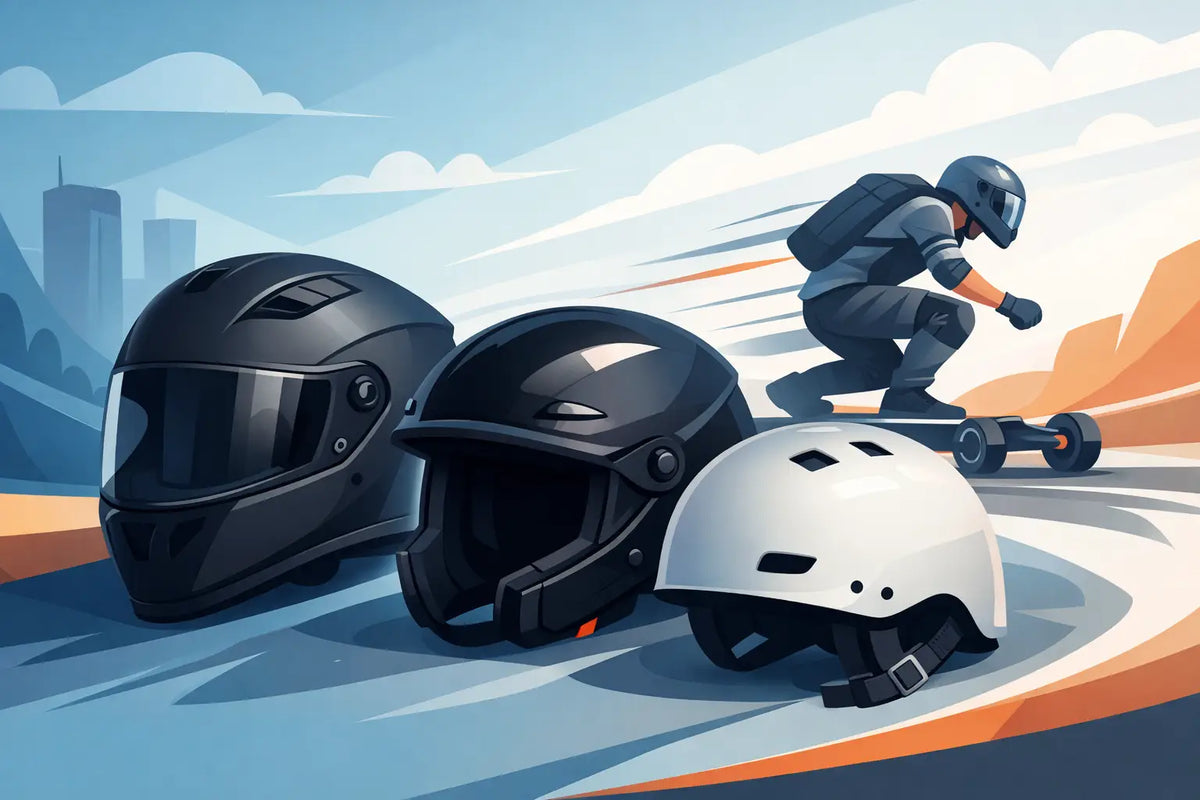
A helmet that feels fine at 12 mph can become the weak point of your setup at 25 mph. That is why the top electric skateboard helmets are not simply the most popular skate helmets. They need to manage higher-speed impacts, remain stable in wind, preserve your peripheral vision, and stay comfortable enough that you wear them for every ride.
For a relaxed neighborhood cruise, an open-face helmet with legitimate certification may be the right call. For a high-performance street board, steep descents, long commutes, or any ride where traffic is part of the equation, more coverage is usually the smarter investment. The right choice depends on your speed, route, posture, and tolerance for heat, not on what looks fastest in a product photo.
What Makes an Electric Skateboard Helmet Different?
Electric skateboard riders do not fall exactly like cyclists, mountain bikers, or traditional park skaters. A powered board can carry you into an unexpected pothole, loose gravel, wet paint stripe, or braking error with considerably more speed than a push ride. The board may also continue moving after you come off it, which makes the first impact unpredictable.
That is why retention, coverage, and fit matter as much as the shell itself. A loose helmet can shift when you turn your head for a shoulder check. An open-face model leaves the jaw and lower face exposed. A full-face helmet adds meaningful protection in a forward slide, but it can be hotter, heavier, and less convenient for quick city stops.
Certification is your starting point, not the finish line. For US riders, look for a helmet certified to CPSC requirements at a minimum. ASTM F1492 is relevant for skateboarding use, while downhill mountain bike certifications are worth considering for riders using full-face helmets at higher speeds. Features marketed as rotational-impact systems can be valuable, but they are not a replacement for proper certification and a secure fit.
Top Electric Skateboard Helmets by Riding Style
There is no single best helmet for every electric skateboard rider. The best option is the one built for the forces and environment you actually ride in.
Full-face helmets for high-speed street riding
A full-face helmet is the serious choice for riders running powerful boards, riding fast paved routes, or carving hills where a mistake can turn into a long slide. Models such as the TSG Pass Pro are popular in the electric skateboard scene because their compact shell profile, broad field of view, and enclosed chin-bar design suit stand-up riding better than many bulky motocross helmets.
A quality full-face lid protects areas that open-face helmets cannot: chin, jaw, teeth, and much of the lower face. That matters when you are moving quickly enough that a forward fall is more likely to involve pavement than a controlled roll.
The trade-off is real. Full-face helmets run warmer, require more storage space, and may feel restrictive to riders used to an open deck and open air. Prioritize a clear, distortion-free visor, dependable venting, and a shape that does not block your upward or side vision. If a visor fogs easily or the chin bar sits uncomfortably close to your face, you will find reasons not to wear it.
Downhill mountain bike helmets for aggressive carvers
Lightweight downhill mountain bike helmets are a strong alternative when you want full-face coverage without the weight and insulation of a motorcycle-style helmet. Options in this category, including the Fox Proframe RS and Smith Mainline, are designed around ventilation and active movement. That makes them especially practical for warm-weather carving and longer rides where heat buildup becomes a distraction.
Their open vent structure is both the advantage and compromise. You get better airflow and a lighter feel, but less weather protection than a visor-equipped electric skateboard-specific full-face design. For dry, fast riding, that can be an excellent balance. For cold commutes, rain, or road grit, a sealed visor is often more comfortable.
Convertible helmets for mixed routes
Convertible full-face helmets, such as the Giro Switchblade class of helmet, make sense for riders whose routes change from crowded urban streets to faster paths. With the chin bar installed, you get substantially more facial coverage. Remove it, and the helmet becomes easier to live with for casual, lower-speed riding.
This versatility has a cost: convertible systems are typically heavier and more mechanically complex than a dedicated open-face or full-face helmet. Check that the chin bar locks positively and that you will realistically carry and use it. A removable safety feature left at home does not help on the fast part of your route.
Open-face helmets for commuting and controlled speeds
For many urban commuters, a certified open-face helmet remains the most practical option. A lower-profile skate-style helmet is easier to bring into a store, wear on public transit, and use daily. It also offers the familiar visibility and airflow that many riders prefer in traffic.
Look for a deep-fitting shell that covers the lower rear of the head, an adjustable retention system, and a buckle you can operate reliably with gloves. Premium urban helmets may add a built-in light or dial fit system, which can improve daily usability. Those conveniences are worthwhile, but they should never outweigh certification and fit.
Open-face protection is best reserved for sensible speeds and predictable riding. If your board routinely has the power to reach the upper end of street-riding speeds, the exposed jaw is a compromise you should make consciously, not accidentally.
Fit Is the Performance Feature Most Riders Miss
The safest helmet is not necessarily the thickest or most expensive one. It is the one that stays correctly positioned when you hit rough pavement, look over your shoulder, or take an impact.
Measure the widest part of your head, usually about one inch above the eyebrows, then use the manufacturer sizing chart. Put the helmet on level, with the front edge sitting low enough to protect your forehead. It should feel snug all the way around without creating a pressure point after 10 to 15 minutes.
Fasten the chin strap and perform a simple movement test. Try to roll the helmet forward and backward with your hands. It should move your skin, not rotate freely on top of it. Shake your head side to side and look down as if checking your remote. If the helmet shifts, adjust the pads or retention dial, or try another shell shape.
Head shape matters. Some brands fit rounder heads; others suit longer, more oval profiles. Do not force a poor match because the helmet looks good with your board. A painful hot spot becomes a reason to skip protection, and a loose shell cannot do its job properly.
How to Match Coverage to Your Board and Route
Think about the total ride, not just your average speed. A short route with perfect bike lanes may support a well-fitted open-face helmet. A 15-mile commute with intersections, cars, wet patches, and changing light demands more margin. The same applies to board capability: a compact commuter board and a high-output performance machine should not automatically wear the same level of protection.
For riders pushing high speeds on boards such as ONSRA's performance-focused lineup, a full-face or downhill-rated option is the more disciplined choice. It protects the part of your body most likely to meet the road first in a hard forward crash. Add gloves with palm protection, abrasion-resistant clothing, and lights if you ride around traffic or after dark. A helmet is central to your setup, but it is not the entire safety system.
Ventilation also deserves more attention than it gets. A helmet that overheats you on a summer ride can reduce concentration and tempt you to unbuckle or remove it at the wrong time. Conversely, a heavily vented model can be miserable in cold wind. Choose for your actual climate, and consider a thin liner or neck gaiter when conditions demand it rather than sizing up into a loose helmet.
When to Replace Your Helmet
Replace any helmet after a meaningful impact, even if the exterior looks nearly untouched. EPS foam liners are designed to absorb energy by crushing, and that damage may not be visible from the outside. Also replace a helmet with cracked foam, damaged straps, a loose buckle, compromised visor hardware, or a shell that has degraded from age and sun exposure.
Avoid buying used helmets unless you know the full history and can inspect them thoroughly. A bargain is not a bargain if the helmet has already done its one big job. Store your helmet away from extreme heat, harsh solvents, and the loose hardware in a car trunk that can scratch or compromise it.
The best helmet is the one that fits your head, matches your real riding speed, and is on your head before the remote leaves neutral. Choose coverage with the same seriousness you bring to wheels, brakes, trucks, and battery power.
Electric Skateboard Wheel Upgrades That Matter
Choosing an Urban Commuter Electric Longboard