
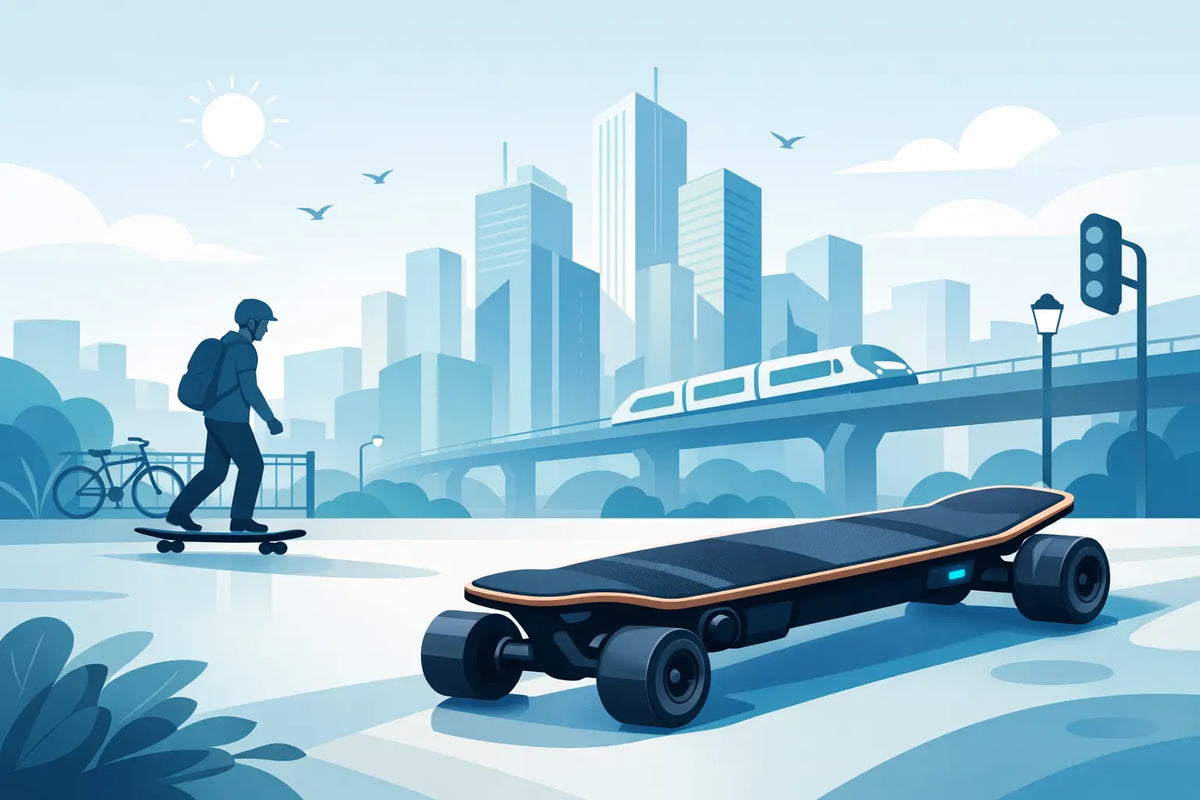
A missed train, a mile of broken pavement, and a backpack full of work gear will expose a weak setup fast. An urban commuter electric longboard is not chosen by its top-speed number alone. It has to start cleanly in traffic, brake with control at intersections, absorb rough streets, and still leave enough battery for the ride home.
That is why serious commuters should shop differently than riders chasing a weekend speed run. City riding rewards usable range, predictable control, serviceable hardware, and the confidence to ride the same route five days a week.
What Makes an Urban Commuter Electric Longboard Different
Commuting is stop-and-go riding. You accelerate from lights, slow for pedestrians, thread through uneven bike lanes, cross expansion joints, and deal with pavement that has not seen maintenance in years. The board needs to make those moments manageable instead of turning every block into a test of balance.
A commuter-focused setup should feel stable at everyday cruising speeds, not nervous or overly reactive. Deck geometry, truck tuning, wheel size, and drivetrain response all contribute. A board that feels exciting on a smooth empty road can be tiring in a dense urban environment if it is too stiff, too twitchy, or too harsh over cracks.
There is also the ownership side. Daily riding puts real mileage on bearings, tires or wheels, belts, bushings, and batteries. Premium hardware costs more upfront, but it should be supported by replacement parts, clear service options, and a warranty that matches how often the product will be used. A commuter cannot afford to treat a drivetrain issue as the end of the board's life.
Start With Your Route, Not the Spec Sheet
Before comparing models, measure the route you actually plan to ride. Note the round-trip distance, elevation changes, road surface, and where you can safely carry or store the board. A six-mile route on flat, clean bike paths is a different use case from a four-mile route with steep hills, potholes, and several rail crossings.
Range should be evaluated with margin. Manufacturer estimates are commonly measured under favorable conditions, while cold weather, hills, rider weight, aggressive acceleration, and soft tires all reduce real-world results. If your daily round trip is 10 miles, a board advertised for 10 miles is not a practical commuter choice. Aim for enough capacity to finish the day without draining the pack to the edge on every ride.
The same logic applies to speed. Most city commuters do not need maximum speed as their first priority. What matters more is controlled acceleration, a comfortable cruising pace, and enough reserve power to climb an overpass or keep momentum on a gradual hill. High power is valuable when it is delivered smoothly through a well-tuned remote and drivetrain.
Hills Demand Torque and Braking Confidence
A route with elevation changes changes the entire buying decision. Climbing requires torque, but descending is where the system needs to earn your trust. Regenerative braking can return energy to the battery, but its real benefit to commuters is controlled speed management.
Be aware of a common limitation: regenerative braking may be reduced when the battery is fully charged. Do not begin a steep downhill immediately after charging to 100% and assume the braking response will feel identical. Learn the board's braking behavior in a safe, open area before taking it into traffic, and always leave room to foot brake or step off if conditions demand it.
Wheels Decide How the City Feels
For urban riding, wheel choice is one of the most important comfort and safety decisions you will make. Smaller, harder street wheels can feel quick and precise on clean pavement, but they transmit more vibration and lose composure on rough asphalt. Larger wheels, pneumatic tires, or all-terrain setups add rolling comfort and help the board handle seams, debris, and uneven surfaces.
There is a trade-off. Larger wheels and pneumatic tires generally add weight, reduce efficiency, and require more maintenance. Tires need pressure checks and can puncture. Street wheels are lighter and simpler, often making a board easier to carry into an office or apartment. The right choice depends on your local roads, not on a universal rule.
If your route includes rough pavement every day, prioritize compliance and traction. If it is mostly smooth urban trail riding with a few sidewalks and crossings, a quality street-wheel setup may be the more efficient choice. Either way, inspect wheels regularly for chunks, flat spots, and worn tread. A commuter board should not be ridden until a failure forces the issue.
Stability Comes From the Whole Chassis
Deck length and stance room matter when you are carrying a bag, looking over your shoulder, or riding through unpredictable traffic. A stable platform gives you more room to shift your feet and absorb vibration. Concave should lock you in without making it hard to adjust your stance during a longer ride.
Trucks deserve equal attention. Precision-machined components, quality bushings, and solid mounting hardware support predictable turns and reduce unwanted movement at speed. Loose trucks can make low-speed carving fun, but too much steering response can feel unstable when you need to hold a clean line through a narrow bike lane. Start with a balanced setup, then tune bushings and truck tightness gradually.
This is one reason ONSRA builds for serious ownership rather than novelty riding. CNC-machined components and a complete replacement-parts ecosystem matter when your board is transportation, not something that sits in a closet between weekend sessions.
Battery Care Is Commuter Care
A high-capacity battery is only useful if it is treated correctly. Use the charger intended for the board, keep the charge port clean and dry, and avoid leaving the pack fully depleted for long periods. If the board will sit for weeks, store it at a partial charge in a dry, moderate-temperature space.
Heat is another practical concern. Do not charge a battery immediately after a hard ride if it is noticeably warm. Give it time to cool, then charge on a nonflammable surface where you can monitor it. Avoid makeshift charging setups, damaged cables, or chargers with loose connectors.
For regular commuting, build a charging routine around your schedule. Some riders charge overnight; others top up at work. Either can work when done safely, but the best routine is the one that prevents last-minute range anxiety and keeps you from routinely running the battery to empty.
Gear and Carrying Strategy Matter More Than You Think
An electric longboard changes how quickly you move, not how protected you are in a fall. Wear a certified helmet every ride. Wrist guards are particularly valuable because instinctive hands-first falls are common, while knee and elbow protection make sense for riders learning a new route, riding in wet conditions, or commuting at higher speeds.
Your backpack should be compact and secure. Loose straps can interfere with movement or catch on the board during a stop. Keep essentials low and close to your back, and protect electronics from weather. If you need to carry the board frequently, account for its full weight before buying. A powerful, long-range machine may be excellent on the road but inconvenient up three flights of stairs.
Visibility is part of your safety system too. Use front and rear lights where appropriate, wear visible outer layers after dark, and ride as though drivers have not seen you. Choose routes with protected lanes, lower traffic speeds, and predictable intersections whenever possible. The fastest map route is not always the best board route.
Build a Setup You Can Maintain
A commuter board should be inspected as routinely as a bicycle. Before riding, check that wheels spin freely, hardware is tight, the remote is charged, and the enclosure shows no damage. Pay close attention after wet rides or impacts with curbs and potholes.
Keep a small maintenance kit at home with the correct skate tool, spare hardware, cleaning cloths, and any drivetrain-specific items your setup needs. Belts, bearings, bushings, tires, and inner tubes are wear items, not permanent parts. Replacing them before performance deteriorates protects both ride quality and safety.
Also check your local rules. Electric skateboard classifications, speed limits, helmet requirements, and access to bike lanes or sidewalks vary by city and can change by district. A board that is mechanically capable of a route may still not be legal or welcome on every section of it.
The right commuter setup makes the city feel smaller without asking you to compromise on control. Choose for the roads you ride, leave range in reserve, maintain the components that take the abuse, and let every daily trip build the skill that makes the next one better.
Top Electric Skateboard Helmets for Fast Riders
Electric Skateboard vs Electric Scooter: Which Fits?