
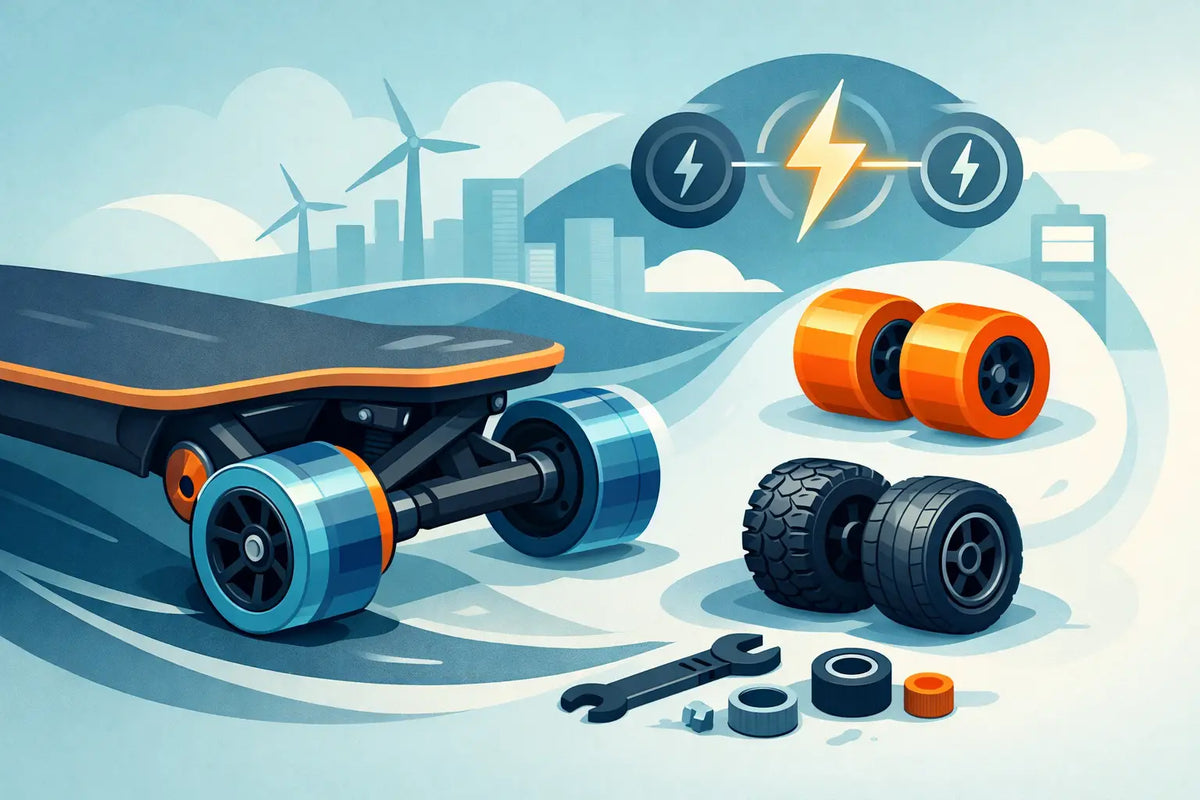
A wheel change can make your board feel like a different machine before you touch the ESC settings or add a single watt-hour of battery capacity. The right electric skateboard wheel upgrades can calm broken pavement, sharpen turn-in, add confidence in fast sweepers, or give an all-terrain setup the bite it needs. The wrong choice can reduce range, compromise clearance, and turn a powerful board into a sluggish ride.
Wheels are where your board meets the road. That makes them one of the most meaningful upgrades available, but only when they match your terrain, riding style, drivetrain, and deck geometry. Bigger is not automatically better. Softer is not automatically safer. Start with the ride you want, then build the setup to support it.
What Wheel Upgrades Actually Change
Wheel diameter changes the effective gearing of your electric skateboard. A larger wheel travels farther per motor revolution, which can improve top-speed potential but reduce low-end torque and braking force at the ground. A smaller wheel does the opposite: it accelerates harder, brakes more aggressively, and generally feels more responsive, although it reaches its speed limit sooner.
Width and contact patch affect how planted the board feels. More urethane or rubber on the road can add stability and grip, particularly when carving hard or riding loose surfaces. That same grip can make a board feel less nimble and may increase rolling resistance. For urban riders, the best wheel is often the one that keeps the ride predictable through cracks, painted lines, rough asphalt, and imperfect corners.
Durometer matters too. Softer wheels absorb vibration and conform to uneven ground, giving you more grip and a smoother ride. Harder wheels roll efficiently on clean pavement and can feel more precise, but they transmit more impact into your feet and deck. On an electric skateboard, where speed amplifies every road defect, comfort is also control.
Street Wheels: Fast, Precise, and Efficient
Street wheels are the right call for riders who spend most of their time on decent pavement, bike paths, and clean urban routes. They are typically smaller and lighter than pneumatic options, so they preserve the quick acceleration and direct handling that make a performance street board fun.
A quality urethane street wheel is not just about hardness. Its formula, lip shape, core design, and profile determine how it grips and wears. A wide, supportive core helps maintain shape under the high torque of belt or gear drives. A rounded lip allows smoother transitions in a carve. A square edge can offer more grip but may feel more locked in.
For commuting, a mid-size street wheel is often the practical sweet spot. It keeps the board compact, maintains useful braking authority, and offers enough rollover ability for normal pavement seams. For aggressive carving, prioritize predictable rebound and a profile that transitions smoothly from edge to edge. If your route has sharp cracks, brick sections, or neglected asphalt, do not expect a street wheel to erase those limits. It will only make the best of them.
When Bigger Street Wheels Make Sense
Moving to a larger urethane wheel can be a smart upgrade for riders who want a little more comfort and obstacle clearance without moving to pneumatic tires. The gain is real: expansion joints and small debris become less abrupt, and higher cruising speeds can feel more relaxed.
The trade-off is drivetrain compatibility. Larger wheels may require different pulleys, belts, risers, or motor mounts to prevent wheelbite and keep the belt path aligned. They also change gearing. A board that felt explosive with smaller wheels can feel softer off the line after a large-diameter swap. Check the manufacturer’s supported wheel range before ordering parts, not after mounting them.
Pneumatic Wheels: Comfort With Real Trade-Offs
Pneumatic wheels are built for roads that do not deserve the word smooth. Air-filled tires dramatically improve vibration damping and rollover, making rough pavement, gravelly paths, and uneven park routes more manageable. They also create a more stable, confidence-inspiring platform at speed, especially on longer boards designed for mixed terrain.
That comfort comes at a cost. Pneumatic setups are heavier, less efficient, and more maintenance-intensive than urethane. The added rotating mass can reduce acceleration, while tire flex and rolling resistance typically reduce range. Riders should also expect to monitor tire pressure, inspect tread, and deal with the possibility of punctures.
Pressure is part of the tuning. Higher pressure generally rolls faster and feels more responsive, but it transmits more vibration and can reduce grip on rough surfaces. Lower pressure increases comfort and mechanical traction, yet it can feel vague in hard turns and raises the risk of pinch flats or tire burping on aggressive riding. Stay within the tire manufacturer’s pressure range, then adjust gradually based on rider weight, terrain, and riding speed.
For all-terrain boards, tire tread deserves as much attention as tire size. A road-oriented tread is quieter and more efficient on pavement. A deeper, more open tread works better on loose dirt and hardpack but can feel slower and less precise on the street. Choose based on the surface you ride most, not the occasional trail you hope to explore.
Electric Skateboard Wheel Upgrades Need Compatibility Checks
The most expensive wheel setup is the one that does not fit. Before changing wheels, confirm the mechanical and electrical consequences of the upgrade.
First, identify your drivetrain. Hub-drive boards have far fewer wheel options because the motor is integrated into the wheel. Some systems accept sleeves, but sleeve compatibility is specific to the motor design. Belt-drive and gear-drive boards offer more flexibility, although pulley and wheel-core standards still matter. A wheel can have the right diameter and still be incompatible with your pulley.
Next, check clearance at full compression and full steering angle. Larger wheels can contact the deck, enclosure, motor mount, or truck hardware during deep carves. Risers can create clearance, but they also raise ride height and may change the board’s handling. On a high-performance setup, a few millimeters matter.
Then consider gearing and remote settings. If your board allows wheel-diameter configuration, update it after a size change so the speedometer and odometer remain accurate. More importantly, test acceleration and braking in a controlled area. Larger wheels can noticeably soften braking, and that is not something to discover on a steep hill or in traffic.
Finally, match the wheel to the board’s intended use. A light street board does not become an all-terrain machine because it wears chunky tires. Its deck, trucks, battery placement, motors, and enclosure still set the limits. Purpose-built hardware performs better and lasts longer than a mismatched conversion.
How to Choose the Right Setup
Think about your last ten rides. If most were fast urban laps on decent asphalt, premium street wheels are likely your best return on investment. You will keep the board’s natural response while gaining grip, comfort, or durability depending on the formula and size you choose.
If your daily route includes cracked streets, rough concrete, and frequent surface changes, larger urethane or pneumatic wheels can reduce fatigue and improve safety margins. The smoother ride is not merely a luxury. When your feet and knees are not absorbing every impact, you can maintain better body position and make cleaner decisions at speed.
If you ride gravel paths, hardpack, or mixed terrain regularly, choose pneumatic tires and accept the range penalty as part of the package. Carry the right tools and understand how to inspect a tire before a ride. A pressure check takes less time than dealing with a flat miles from home.
Riders upgrading a premium platform should prioritize properly engineered components over generic fitment claims. At ONSRA, that means selecting wheels, tires, pulleys, and hardware designed to work together rather than forcing an almost-compatible setup into service. Reliable performance starts with correct interfaces.
Install Carefully, Then Relearn the Board
After installing new wheels, spin each one freely and check for rubbing, uneven belt tracking, loose hardware, and bearing drag. Tighten axle hardware securely, but do not crush bearings by overtightening. On pneumatic setups, make sure both sides are set to the same pressure unless you have a specific reason to tune them differently.
Your first ride should be a systems check, not a speed run. Test braking at low speed, make full-depth carves to verify clearance, and listen for belt chatter or tire rub. Give yourself a few rides to recalibrate. A wheel upgrade changes the feedback your body relies on, especially during braking and high-speed turns.
Choose the wheel that makes your regular route better, then give it the maintenance and respect it deserves. That is how an upgrade becomes more than a new look - it becomes a board you want to ride farther, harder, and more often.
Electric Skateboard Remote Replacement Guide
Top Electric Skateboard Helmets for Fast Riders