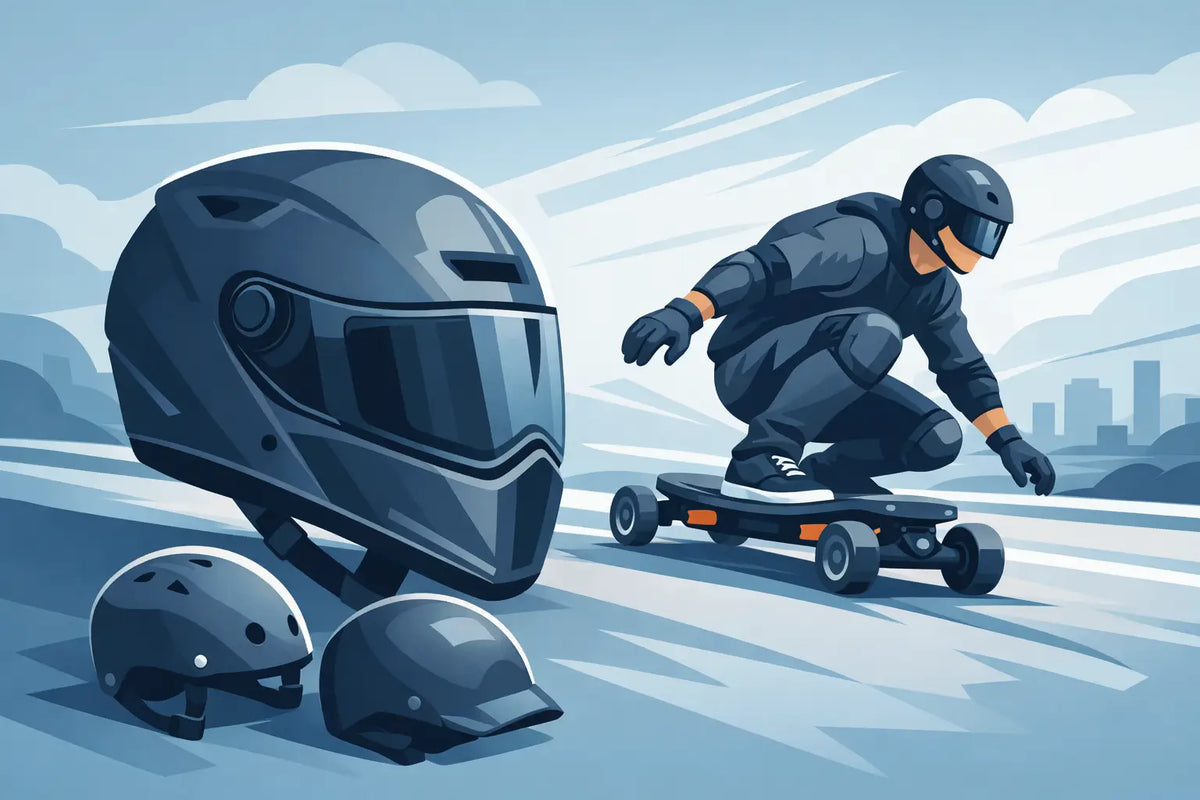
A fast electric skateboard turns a familiar piece of protective gear into critical equipment. Eskate helmets need to handle more than a low-speed sidewalk spill: they need to stay planted through acceleration, vibration, carving, wind, and the possibility of a hard impact far from home. The right helmet should disappear while you ride and show up when the pavement does.
What Makes Eskate Helmets Different?
Electric skateboarding sits between traditional skating, cycling, and light motorcycle riding. You stand sideways, your falls can involve sliding or tumbling, and many performance boards reach speeds where reaction time gets short fast. That changes what a serious rider should expect from a helmet.
A basic skate helmet can be a solid choice for relaxed neighborhood riding, especially when it fits correctly and carries a recognized skateboard certification. But speed, traffic exposure, rough pavement, night riding, and all-terrain use raise the stakes. As your board's capability increases, coverage, retention, and impact management deserve more attention.
The goal is not to buy the largest or most aggressive-looking shell. It is to choose a helmet designed for your riding environment, with a secure fit and credible safety certification. Premium construction matters, but it cannot compensate for a loose helmet, damaged foam, or the wrong design for the ride.
Start With Your Actual Riding Speed and Terrain
Be honest about where and how you ride. A rider cruising bike paths at moderate speed needs something different from a commuter mixing with cars or a VELAR rider charging long, fast stretches of rough pavement.
For lower-speed street carving and casual sessions, an open-face skate-style helmet offers excellent awareness, good ventilation, and a natural feel. Look for a deep shell that protects the back of the head, not a shallow fashion helmet that perches above it. A secure adjustable retention system and strong chin strap are more valuable than flashy graphics.
For faster riding, dense urban traffic, wet conditions, gravel, or all-terrain sessions, a full-face helmet is worth serious consideration. It adds chin and face protection, blocks wind, and can reduce fatigue at speed. The trade-off is clear: full-face models are heavier, warmer, and may slightly reduce peripheral awareness or make it harder to hear surrounding traffic. Riders need to compensate by checking intersections deliberately and avoiding overly isolated audio setups.
Modular helmets offer convenience, but the hinge mechanism adds complexity and weight. For hard riding, a purpose-built full-face design with a secure closure is often the more confidence-inspiring option.
Open-Face, Full-Face, or Downhill Style?
An open-face helmet is the practical everyday choice for riders who prioritize airflow and visibility. A full-face helmet is the stronger option when speed and impact exposure rise. Downhill longboard helmets can also make sense because they are built around a tucked, high-speed stance, though their ventilation and visibility vary widely by model.
Do not choose a downhill or motorcycle-inspired helmet only because it looks fast. Confirm that the field of view works in your normal riding posture. You should be able to look over your shoulder, scan cross traffic, and see the road surface close ahead without fighting the shell or visor.
Fit Is the Safety Feature You Feel Every Ride
The best helmet on paper is ineffective if it moves on your head. Fit is where serious protection starts.
Measure the circumference of your head about an inch above your eyebrows, then use the manufacturer's sizing chart. Helmet sizes are not standardized, so a medium from one brand may fit very differently from a medium in another. If you are between sizes, follow the specific brand's guidance and use the included pads or retention adjustment to fine-tune the fit.
A correctly fitted helmet should sit level, low on the forehead, and cover the back of the skull. It should feel snug around the entire head without creating sharp pressure points. With the chin strap fastened, try to roll the helmet forward and backward. Your skin and eyebrows should move with it. If the shell rotates freely, lifts off, or shifts during a hard head shake, it is not secure enough.
The chin strap should be snug beneath the jaw, with only enough room for one or two fingers. A loose strap turns a protective shell into an expensive accessory that can come off in the first impact.
Break In Before You Commit
Wear a new helmet indoors for 15 to 20 minutes before taking it on a long ride. Some liners settle slightly, but painful pressure on the forehead or temples usually does not disappear with time. A helmet that distracts you will end up hanging from your handlebars or strapped to a backpack, which defeats the point.
Hair, beanies, headphones, and eyewear also affect fit. Do not size up simply to make room for bulky accessories. Thin helmet-compatible liners are a better cold-weather solution, and glasses should sit comfortably without pushing the helmet out of position.
Certifications Matter, but They Are Not a Speed Rating
Look for helmets certified to recognized standards relevant to their intended use. In the US, CPSC certification is common for bicycle helmets, while ASTM F1492 is associated with skateboarding and roller skating helmets. Some models carry more than one certification, which can be useful for riders who move between pavement, paths, and skate-style riding.
Full-face options may use motorcycle-oriented standards such as DOT or ECE 22.06. These standards test helmets differently and can be relevant for riders seeking greater coverage at higher speeds. Certification labels are not marketing decoration. They indicate that the helmet was tested against a defined standard.
Still, no sticker tells the full story. A certified helmet is not a promise that any impact is harmless, and no standard can account for every surface, speed, angle, or secondary collision. Certification should be the baseline, followed by fit, condition, coverage, and the way you actually ride.
Technologies designed to manage certain rotational forces can be worthwhile, especially for riders spending long hours on pavement. Treat them as an added layer, not a substitute for proper fit or a reason to ride beyond your limits.
Build Quality Details That Pay Off
At electric skateboard speeds, small design details affect whether you keep wearing a helmet. Ventilation channels help on summer commutes, but more vents can mean more wind noise and more exposure to rain or cold. Choose airflow based on your climate and ride length, not just the number of openings in the shell.
A visor can protect your eyes from wind, grit, insects, and low sun. Clear visors are useful after dark, while tinted lenses belong in bright daytime conditions only. Never ride into dusk with a dark visor you cannot see through. If your helmet does not use a visor, quality eyewear with secure retention can provide protection without blocking peripheral vision.
Look closely at the retention hardware, padding, buckle, and shell finish. Magnetic buckles are convenient with gloves, while a traditional double D-ring closure is simple and proven. Removable, washable liners make a real difference for riders who commute or train often. Reflective elements or a rear light mount can also improve your visibility, though they do not replace active lighting on the board and your body.
When to Replace an Eskate Helmet
Replace a helmet immediately after a significant impact, even if the outer shell looks fine. The energy-absorbing liner can be compressed or damaged internally, leaving less protection for the next crash. Do not buy a used helmet unless you can verify its full history, age, storage conditions, and absence of impacts. In most cases, the savings are not worth the uncertainty.
Heat, UV exposure, sweat, solvents, and years of daily use also take a toll. Follow the manufacturer's replacement guidance, inspect straps and foam regularly, and store the helmet away from direct sun and high heat. Avoid hanging it from your board where it can strike the ground, trucks, or curb every time you stop.
Your helmet works best as part of a complete riding setup. Gloves protect the hands that instinctively reach for the ground. Knee and elbow pads can prevent a manageable slide from becoming a ride-ending injury. Lights, predictable riding, and speed control reduce the chance that the helmet ever has to do its job.
Choose protection that matches the board beneath your feet, secure it properly, and make it part of every ride. Confidence should come from preparation and control, not from assuming the road will give you a second chance.
What Ebike Warranty Coverage Should Include
Are Ebike Chargers Universal? The Safe Answer