
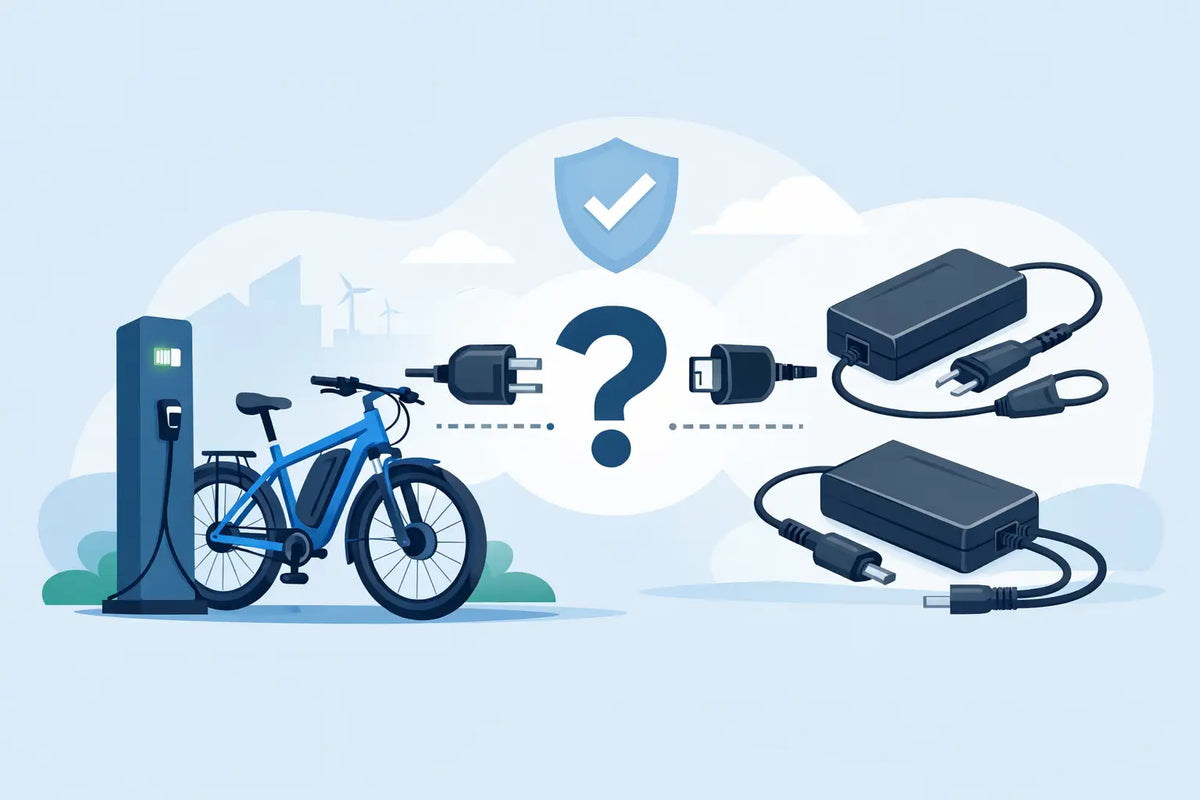
A replacement charger can look right, plug in cleanly, and still be completely wrong for your battery. That is why the answer to are ebike chargers universal is a firm no. E-bike chargers are electrical equipment built around a specific battery system. Treating them as interchangeable can mean slow charging, a damaged battery, a failed battery-management system, or a serious fire risk.
For a performance-focused rider, this is not a minor accessory decision. The charger is part of the drivetrain ecosystem. It determines how safely and consistently your battery is replenished between commutes, trail miles, and long weekend rides. The right replacement is not simply the one with the matching plug. It is the one that matches the full electrical specification of your bike.
Are Ebike Chargers Universal? No, and Here Is Why
An e-bike battery is not charged by a generic amount of power. It requires a charger with the correct output voltage, connector, polarity, charging current, and in some cases, communication protocol. If one of those elements is wrong, the setup is not compatible.
The most common misunderstanding comes from battery labels. A battery advertised as 36V does not typically use a 36V-output charger. Its nominal voltage is 36V, while a standard 10-cell lithium-ion pack reaches approximately 42V when fully charged. A conventional 48V battery generally needs a 54.6V charger, while a 52V battery generally needs a 58.8V charger.
That difference matters. Connecting a lower-voltage charger may leave the battery undercharged or may not start charging at all. Connecting a charger with too high an output voltage can overcharge cells if the battery protection system cannot stop it, creating a condition no rider should gamble on.
Voltage is only the first check. Two chargers can both be marked 54.6V and still be unsuitable for each other because their plugs, wiring, polarity, current output, or control electronics differ.
The Five Compatibility Checks That Matter
Before buying or using a replacement, read the label on your original charger and battery. If the original charger is missing, use the specifications supplied by the bike manufacturer, not a guess based on what another rider uses.
1. Charger Output Voltage
Start with the charger label, specifically its DC output. This is the number that must match the battery system's required charging voltage. Do not confuse it with AC input, which often reads 100-240V and refers to the household power the charger can accept.
Common lithium-ion charging outputs include 42V for 36V nominal batteries, 54.6V for 48V nominal batteries, and 58.8V for 52V nominal batteries. These figures are common, not universal rules for every pack chemistry or battery architecture. The manufacturer's specification always wins.
A charger intended for a lead-acid system, lithium iron phosphate pack, or another specialty chemistry is not automatically appropriate just because its printed voltage looks close. Charging profiles differ, and battery chemistry is not a detail to overlook.
2. Connector Type and Pin Layout
Round barrel plugs, three-pin connectors, magnetic connectors, XLR-style plugs, and proprietary ports can all appear on e-bikes. A connector that physically fits is not proof of compatibility. The positive and negative contacts must be in the correct positions, and multi-pin connectors may carry data or temperature signals in addition to power.
Avoid forcing a plug into a port. Also be careful with universal adapter kits. An adapter can change the shape of a connector, but it cannot correct the wrong voltage, polarity, or charging logic. At best, it is only one piece of a properly matched charging setup.
3. Polarity
Polarity tells you which contact carries positive power and which carries negative power. Barrel connectors often display a small center-positive or center-negative diagram on the charger label. Matching connector dimensions with reversed polarity can damage electronics immediately.
This is one reason a no-name replacement charger is a poor place to cut costs. Clear labeling, correct protection circuitry, durable strain relief, and a properly built connector all matter when the device is regularly handling high energy near your battery pack.
4. Charging Current and Wattage
Amperage affects how fast a charger delivers energy. A 2A charger is usually slower and gentler than a 4A or 5A charger, assuming every other specification is compatible. Higher current can shorten downtime, but only if the battery, battery-management system, charge port, and manufacturer all support it.
More amps are not automatically better. A battery designed around a lower charging rate may run hotter with a high-current charger, and heat is one of the biggest long-term enemies of lithium-ion cells. Fast charging is valuable for riders who need quick turnarounds, but it should be engineered into the system, not improvised after the sale.
Charging wattage is the result of voltage multiplied by current. For example, a 54.6V, 2A charger supplies roughly 109 watts, while a 54.6V, 4A charger supplies roughly 218 watts. Both may serve a 48V battery system, but only if the battery maker approves both charge rates.
5. Battery Communication and Smart Systems
Many modern e-bikes use a battery-management system, or BMS, to monitor cell voltage, temperature, current, and charging status. Some systems also use dedicated communication between charger, battery, and bike. This is especially common in integrated batteries and premium designs where the brand controls the complete electrical system.
A generic charger may power up but fail to initiate a proper charge cycle. In other cases, it may bypass features the original system uses to manage temperature or battery health. For bikes with smart batteries, proprietary connectors, or integrated charging ports, an approved charger is usually the only sensible choice.
How to Choose a Replacement Charger Safely
The strongest move is to replace like with like: buy the exact charger specified for your e-bike model and battery. That gives you the correct charging profile, plug fitment, charge rate, and protection design without turning a basic maintenance purchase into an electrical experiment.
If the exact original is unavailable, compare the replacement against your existing charger label line by line. Confirm the output voltage, maximum current, connector type, polarity, and intended battery chemistry. Confirm that the manufacturer explicitly lists compatibility with your battery or bike model. A seller saying a charger is "universal" or "works with most e-bikes" is not meaningful technical confirmation.
Inspect the charger itself before every use. A bent pin, loose connector, damaged cable, cracked housing, or unusual smell is reason to stop using it. Charge on a hard, nonflammable surface in a dry, ventilated area. Do not cover the charger, place it on carpet, or leave a damaged battery connected overnight.
If the charger or battery becomes excessively hot, starts cycling on and off, flashes unfamiliar error lights, or fails to reach a normal full charge, disconnect it and investigate before the next ride. A charger problem can be the first visible sign of a battery or charge-port issue.
Can You Use a Different Brand's Charger?
Sometimes, but only when the specifications are genuinely identical and the battery manufacturer approves the pairing. Brand alone does not determine compatibility. There are cases where a high-quality third-party charger is designed specifically for a known battery platform and is completely appropriate.
The reverse is also true: two products from the same broad category may be incompatible despite sharing voltage and a familiar plug. This is why using a friend's charger because it "looks the same" is a bad habit. Verify every relevant specification first.
For riders who own multiple electric vehicles, keep chargers labeled by vehicle and battery voltage. Electric skateboard, e-bike, scooter, and other personal electric vehicle chargers can use similar connectors while operating at very different outputs. Organization prevents an expensive mistake when you are packing up for a ride.
A Charger Is Part of the Ownership System
A premium e-bike deserves a charger built with the same attention to electrical reliability as the battery, motor, and frame. The right charger protects your investment, supports predictable range, and keeps the battery operating within the limits it was designed to handle.
When in doubt, stop at the label, verify the specifications, and choose the charger made for your exact system. A few minutes of confirmation is far better than risking the component that powers every mile ahead.
Eskate Helmets: Choose Protection for Real Speed
What Electric Skateboard Range Is Needed?