
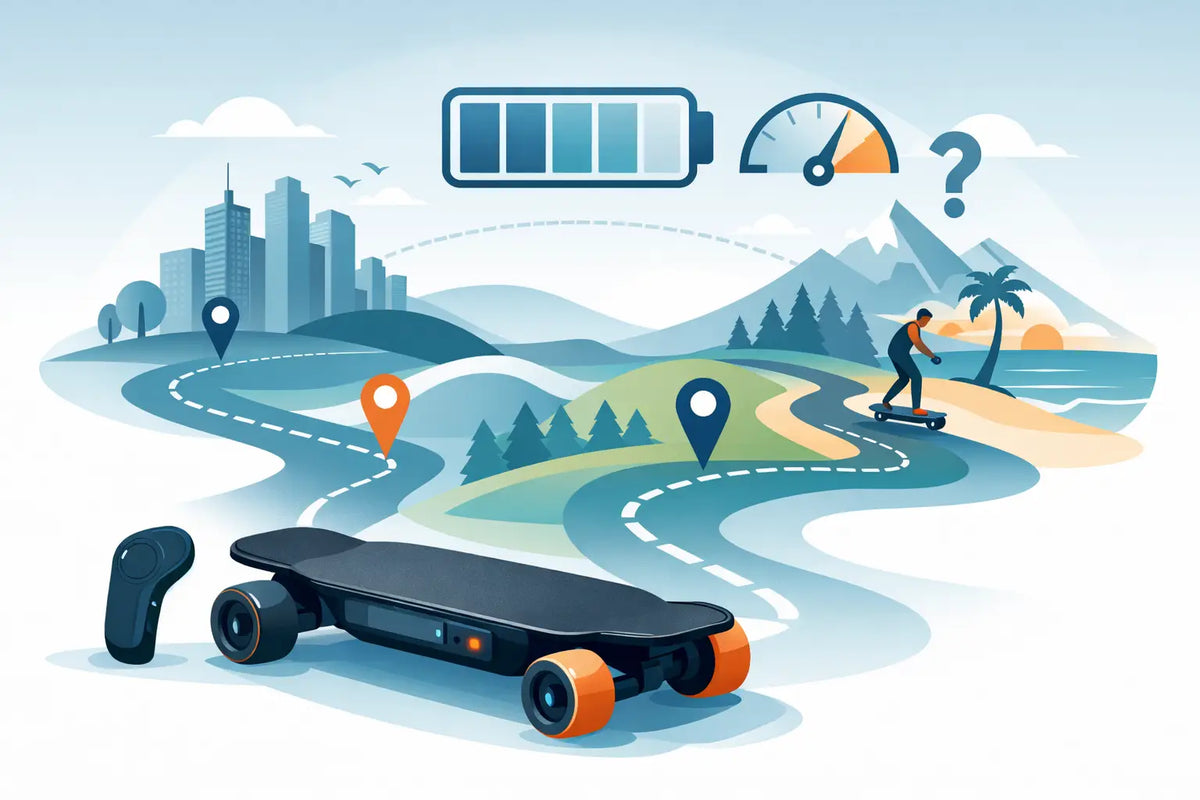
A board that claims 30 miles but leaves you hunting for a ride home after 18 is not the right board for your use. If you're searching “what electric skateboard range needed,” start with your real route, not a marketing number. Range is the operating margin that lets you ride hard, take the long way home, and arrive without draining the battery to its limits.
For most adult riders, the right answer is not a single mileage figure. It is a range target built around commute distance, terrain, rider weight, speed, weather, and how much battery reserve you want when the ride gets interesting.
What Electric Skateboard Range Is Needed for You?
Use your longest normal round trip as the starting point. If your commute is 8 miles each way, your baseline is 16 miles. But buying a board rated for exactly 16 miles would be a mistake. Published range is generally achieved under favorable conditions: a moderate rider, smooth pavement, controlled throttle, mild temperatures, and limited elevation.
A serious rider should normally choose a board with a claimed range at least 1.5 times their regular round-trip distance. For a 16-mile daily commute, that means looking at a real-world capable setup with roughly 24 miles or more of rated range. This buffer covers stops, traffic, a headwind, an extra errand, battery aging, and the fact that few riders want to spend an entire commute feathering the throttle.
If your rides are recreational rather than practical, think in ride time as well as mileage. A 10-mile carving session can feel short if you are covering smooth bike paths at a fast pace. On rough streets, steep grades, or all-terrain tires, that same session may use considerably more energy. More capacity gives you the freedom to choose the route based on the ride, not the nearest outlet.
Rated Range vs. Real-World Range
Electric skateboard range is usually presented as a maximum estimate. It is useful for comparing boards, but it is not a promise that every rider will reach the number. The more relevant question is what percentage of the quoted figure you can expect in your conditions.
For mixed urban riding, a realistic planning number is often 60% to 80% of maximum claimed range. A lightweight rider cruising flat pavement can land near the high end. A heavier rider running high speeds through hills, frequent stops, and cold weather may be closer to the low end. This is not a flaw in a quality board. It is basic energy use.
Speed has an especially large effect. Aerodynamic resistance rises quickly as speed increases, and hard acceleration pulls more current from the pack. Riding at a controlled 15 to 18 mph can stretch a battery dramatically compared with repeated full-throttle bursts at 25 mph or more. The faster setting is fun, but it has a price measured in watt-hours.
Terrain matters just as much. Climbing consumes energy that you do not fully recover on the descent, even with regenerative braking. Rough pavement, soft tires, grass, gravel, and low tire pressure all increase rolling resistance. A range estimate that works for a flat waterfront path may not cover a hilly neighborhood with cracked streets and stop signs every block.
Battery Capacity Is the Number That Matters
When comparing electric skateboards, look beyond a single range claim and examine battery capacity in watt-hours, abbreviated Wh. Watt-hours measure how much energy the pack stores. In simple terms, a larger Wh rating gives the board more fuel to work with.
Voltage and amp-hours matter too, but watt-hours make comparison easier because they combine both figures. A 12S battery at 10Ah has a nominal capacity of about 432Wh. A 12S battery at 20Ah is about 864Wh. Assuming similar motors, gearing, wheels, rider, and terrain, the 864Wh board carries roughly twice the available energy.
That does not mean you should buy the largest battery without considering the rest of the platform. Big packs add cost and weight. They are worth it when range is central to your commute, when you ride terrain that consumes power, or when you value performance that remains strong deeper into the ride. For short, flat trips with charging available at both ends, a smaller pack can be more practical.
The battery should also be matched to the board's quality level. High-output cells, a properly engineered battery management system, durable enclosure protection, and reliable connectors all matter. Capacity is only useful if the pack can safely deliver power under load and remain dependable through years of charging cycles.
Build Your Range Buffer Before You Need It
Do not plan to arrive home at 0%. Deeply draining a lithium battery on every ride is hard on the pack and removes your safety margin. A detour, stronger-than-expected wind, or a hill you forgot about can turn a manageable ride into a long walk carrying a heavy board.
A practical goal is to finish most rides with 20% to 30% battery remaining. That reserve is useful for battery health, but it is also a performance feature. As battery voltage drops, many boards reduce available power to protect the cells. Keeping reserve means you are less likely to lose the acceleration and hill-climbing response you need late in a ride.
For example, consider a rider with a 12-mile round-trip commute. A board with a claimed 15-mile range may complete it on a perfect day, but it leaves almost no room for variation. A board rated around 22 to 25 miles gives that rider a much better ownership experience. They can ride normally, run errands, choose a more enjoyable route, and avoid treating every percentage point as an emergency.
Your Riding Style Changes the Answer
Commuters usually need predictable range more than a huge top speed. If you ride to work, class, or transit, buy for the worst regular day: cold morning, heavier backpack, wind, and a route with stops. A board that comfortably handles this day will feel effortless on every easier one.
Performance riders often need more range than they first expect because aggressive riding uses energy quickly. Fast acceleration, high-speed cruising, hard carving, and hill runs demand more from both the battery and motors. Larger urethane wheels may improve ride comfort and speed efficiency on clean pavement, while pneumatic tires provide grip and control on rougher terrain but can reduce range through added weight and rolling resistance.
Adventure riders should plan even more conservatively. Remote routes do not offer a convenient charger, and off-road surfaces raise energy use. For these rides, capacity is confidence. It gives you room to explore without turning every fork in the trail into a battery calculation.
Rider weight and cargo also belong in the equation. A rider carrying a laptop, tools, groceries, or protective gear is asking the board to move more total mass. There is no universal penalty per pound because terrain and riding style vary, but heavier loads consistently reduce range, especially on climbs and during acceleration.
How to Estimate Your Own Electric Skateboard Range
Start by tracking a few rides with your current board, if you have one. Record distance, battery used, route type, temperature, average speed, and tire setup. After three or four normal rides, you will have a far better reference point than any generic chart can provide.
If you are buying your first board, use your route as a test. Map the full round trip, include likely detours, and identify elevation changes. Then add at least 50% to the distance. Add more if you are above average rider weight, ride in a cold climate, plan to use pneumatic tires, or know you prefer fast acceleration.
Charging access can influence the choice, but it should not excuse an undersized battery. Charging at work is helpful, yet it introduces one more dependency: remembering your charger, finding an outlet, and waiting long enough to recover meaningful capacity. A board with sufficient range for the round trip remains the more capable machine.
Premium long-range setups also tend to make better long-term sense for riders who keep their equipment. Battery performance naturally declines over time. Beginning with ample capacity means the board can still serve your route well after many cycles. That is part of the ownership value behind a performance-focused platform such as ONSRA, where the board, parts, charging equipment, and rider support are designed for more than a season of novelty.
Choose Range for Freedom, Not Just Distance
The best range target is the one that removes battery anxiety without adding unnecessary bulk or cost. For short urban trips, that may mean a board rated for 15 to 20 miles. For a longer commute or frequent weekend rides, 25 to 35 miles is often the stronger target. Riders tackling hills, rough terrain, high speeds, or remote routes should look beyond that and prioritize battery watt-hours, tire choice, and a meaningful reserve.
Buy enough capacity to finish your normal route with power left for the ride you did not plan. That extra margin is where an electric skateboard stops feeling like a gadget and starts feeling like real transportation.
Are Ebike Chargers Universal? The Safe Answer
Skateboard Warranty Claim Example That Works