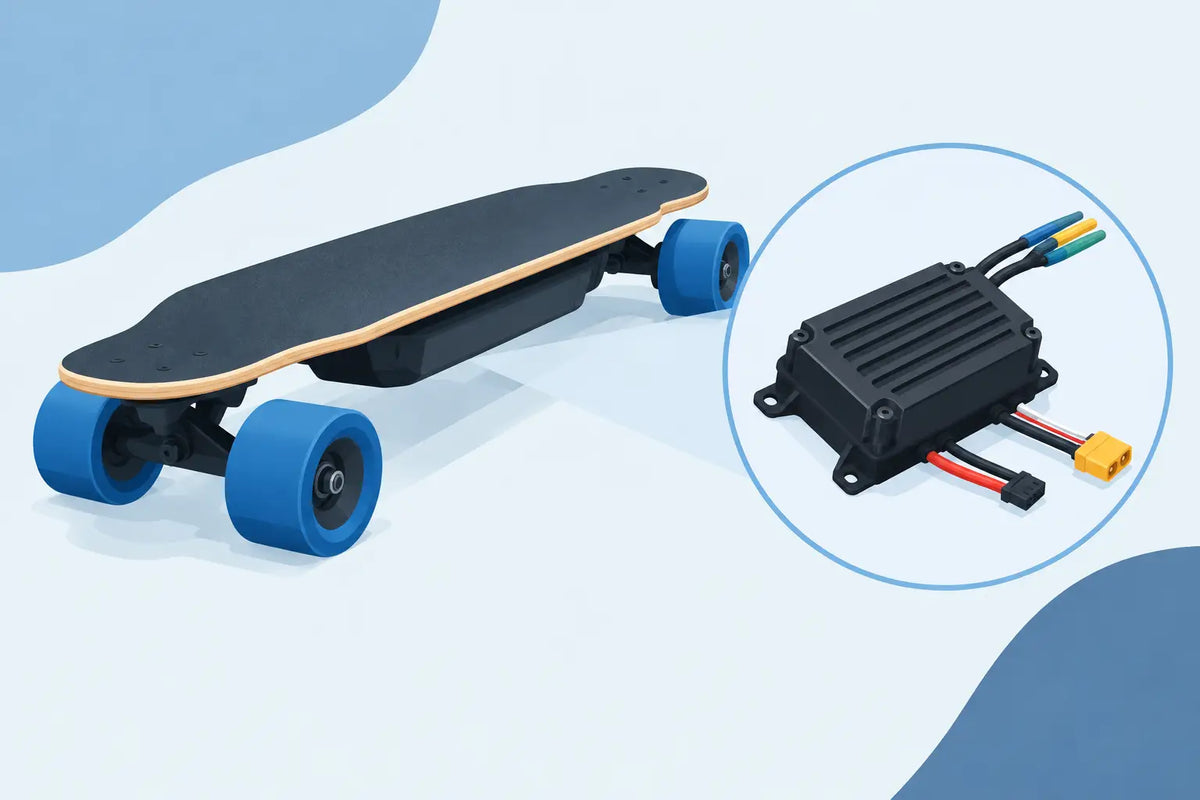
A powerful battery and high-torque motors do not make a great board on their own. Ask, “what is ESC electric skateboard control?” and you are asking about the component that decides how all that power reaches the pavement. The ESC is the electronic speed controller: the board’s control center for acceleration, braking, motor response, and protection systems.
For serious riders, ESC quality is not a background spec. It is the difference between a board that feels predictable through a fast carve and one that feels abrupt, hesitant, or unsettled when conditions change. It also has a direct effect on usable performance, especially under hard acceleration, steep descents, high loads, and sustained riding.
What Is an ESC on an Electric Skateboard?
An ESC is the electronic module that receives your remote input and regulates electrical power from the battery to the motors. When you pull the trigger, the ESC interprets how much acceleration you requested, then sends precisely timed power to each motor. When you release or push the trigger forward to brake, it controls motor resistance to slow the board down.
Think of the remote as the command and the ESC as the decision-maker. It does not simply send full battery power whenever you accelerate. A capable ESC continuously manages current, voltage, motor speed, temperature, and programmed ride settings. This is why two boards with similar battery capacity and motor ratings can feel completely different under your feet.
On a dual-motor setup, the ESC also controls each motor independently. That matters when traction changes from one side of the board to the other, when you are carving, or when you need controlled power rather than a sudden surge.
Why ESC Quality Changes the Ride
The best electric skateboards feel connected. The throttle comes on smoothly from a standstill, power builds with confidence, and braking remains controlled when you need it most. Those traits come largely from ESC tuning and hardware capability.
Throttle response and acceleration
A cheap or poorly tuned controller can make acceleration feel like an on-off switch. That may sound exciting in a product listing, but it is tiring and less stable in real riding. Smooth low-speed modulation lets you roll through traffic, start uphill, and exit corners without upsetting your balance.
At higher speeds, a performance ESC should deliver power progressively rather than flattening out early or pulsing under load. The goal is not always the hardest possible launch. It is usable torque that stays predictable as speed rises.
Braking control
Electronic braking works by using the motors as generators. As the board slows, the motors send energy back toward the battery. This is called regenerative braking, and it is one reason electric skateboards can feel so controlled on rolling terrain.
But regen has limits. A fully charged battery may not be able to accept much returned energy, so braking can be reduced at the start of a ride. Very low battery voltage can also change available braking behavior. A well-designed system communicates battery status clearly and applies braking in a controlled way rather than surprising the rider.
Mechanical brakes are not part of an electric skateboard, so the ESC and your riding judgment matter. Leave room to stop, especially on steep hills, wet pavement, loose surfaces, and unfamiliar routes.
Heat management and sustained output
High current creates heat in the ESC, motors, wiring, and battery. Heat is the enemy of sustained performance. If an ESC cannot shed heat effectively or is programmed too aggressively for its hardware, it may reduce power to protect itself. Riders experience that as a board that feels strong for a few minutes, then noticeably weaker.
Premium controllers use quality power components, thoughtful thermal design, and conservative protection thresholds to balance output with durability. Larger heat sinks, solid enclosure design, and clean electrical connections all help. This is especially relevant for heavier riders, aggressive acceleration, off-road use, long climbs, and hot-weather sessions.
How an ESC Talks to the Battery, Motors, and Remote
An ESC sits between the major electrical systems of the board. The battery provides DC power. The ESC converts and switches that power in a controlled pattern to drive brushless motors. The remote sends rider commands, while sensors and firmware provide feedback that helps the ESC react correctly.
Most modern performance boards use brushless DC motors. The controller creates a rotating magnetic field inside each motor by energizing its phases in sequence. Precise timing is what produces smooth torque. Better control algorithms can improve startup behavior, reduce cogging, and make throttle input feel more natural.
The ESC also works alongside the battery management system, or BMS. The BMS protects the battery cells by monitoring conditions such as voltage, current, and temperature. The ESC manages delivery to the motors. They are related, but they are not the same component. A strong ESC cannot make up for a weak battery pack, and a high-capacity battery cannot compensate for an underbuilt controller.
ESC Settings: More Than a Speed Mode
Many boards offer ride modes such as Eco, Sport, Pro, or Turbo. These modes are typically ESC profiles that alter acceleration strength, top-speed behavior, braking force, and sometimes current limits. They are useful because the same board may need to handle a relaxed commute one day and a hard-charging weekend ride the next.
Advanced ESC systems can also allow tuning for acceleration curves, brake strength, motor direction, wheel diameter, and current limits. Customization is valuable, but it comes with responsibility. Increasing current limits can add stress to the battery, motors, drivetrain, and tires. Stronger braking is not automatically safer if it exceeds your ability to stay balanced.
For most riders, the best setting is the one that gives consistent control. Start conservatively, learn how the board behaves at different battery levels, and increase performance only when your stance and braking technique are ready for it.
VESC and Proprietary ESCs
You may see the term VESC in electric skateboard discussions. VESC originally referred to an open-source electronic speed controller platform that became popular with DIY builders because it offered deep configuration options and strong performance potential. The name is now often used broadly for VESC-compatible or VESC-style controllers.
A proprietary ESC is designed specifically for a manufacturer’s board, battery, motors, enclosure, remote, and warranty requirements. It can provide a more integrated ownership experience, with clean plug-and-play replacement parts and settings tuned for the intended hardware.
Neither approach wins in every case. A VESC-based setup can appeal to riders who enjoy building, diagnosing, and tuning every parameter. A proprietary system often makes more sense for riders who want engineered compatibility, consistent performance, and straightforward support. The right choice depends on whether you value maximum experimentation or a tightly developed complete system.
Signs of a Good Electric Skateboard ESC
Do not judge a controller by one peak-current number alone. A meaningful evaluation includes how it behaves under pressure. Look for smooth throttle mapping, controlled braking, stable connection to the remote, thermal protection, and output that remains consistent through a full ride.
Build quality matters too. Water resistance, secure connectors, protected wiring routes, and a durable enclosure help a controller survive vibration, road spray, and daily use. No electric skateboard should be treated as waterproof, but real-world durability separates a serious platform from a short-lived novelty.
Support is part of the equation. ESCs are complex electronics, and a board is only as serviceable as its parts availability, documentation, and customer support. Brands built around long-term ownership, including ONSRA, understand that riders need more than a fast first ride. They need a platform they can maintain with confidence.
When ESC Problems Show Up
ESC issues can appear as jerky throttle, delayed acceleration, inconsistent braking, random cutouts, overheating warnings, remote disconnects, or one motor failing to respond. Some symptoms may come from another source, including a damaged motor cable, loose connector, failing battery, remote issue, or water intrusion.
If your board behaves unpredictably, stop riding it until you identify the cause. Inspect visible wiring and connectors with the board powered off, check for physical damage, and follow the manufacturer’s diagnostic process. Do not continue testing a board with unreliable braking or acceleration at speed.
The ESC is not the flashiest component on an electric skateboard, but it is one of the most defining. Choose a board with a controller engineered for the power, terrain, and riding style you actually demand. When every input feels measured and every stop feels controlled, you can focus on the line ahead instead of wondering what the board will do next.
Skateboard Chargers That Protect Your Battery
How to Set Tire Pressure for Better Rides