
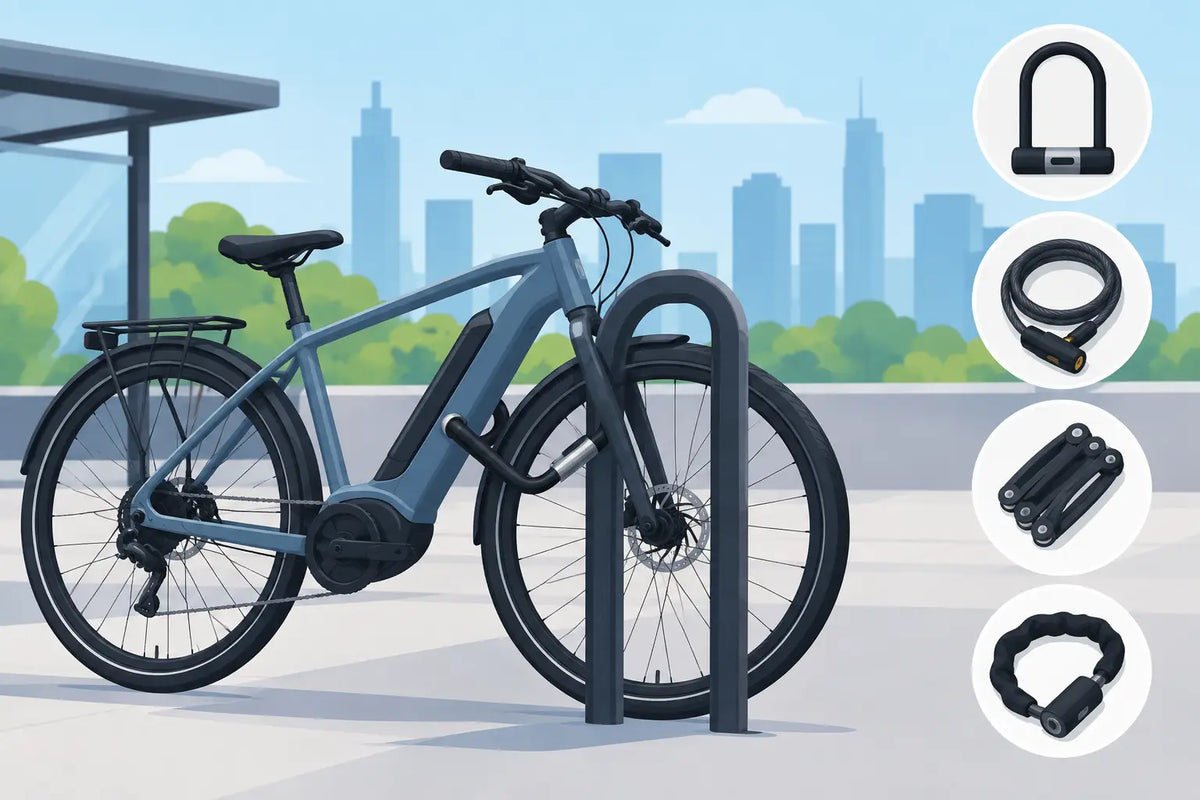
A commuter e-bike is not a cheap bike with a battery bolted on. It is a serious piece of transport, often carrying a high-capacity battery, a powerful motor, premium components, and the miles that make your week work. That is why the best ebike commuter locks are not chosen by price alone. They are chosen around where you park, how long you leave the bike, and how much time a thief can get with it.
For most city riders, a lock is not about making theft impossible. No portable lock can promise that against a determined attacker with enough time and power tools. The goal is to make your e-bike a slow, noisy, difficult target while giving thieves easier options elsewhere. That means hardened steel, a smart locking method, and a parking routine that does not leave expensive components exposed.
What Makes an E-Bike Lock Worth Carrying
The first specification to look for is independent security testing. Sold Secure ratings and ART ratings are useful reference points because they assess resistance to common attack methods rather than relying on marketing language. For a commuter e-bike, look for a high-security U-lock or chain rated for bicycle theft resistance at the strongest level available in your market.
Material matters just as much. Quality locks use hardened alloy steel that resists bolt cutters and slows cutting tools. The shackle or chain links should be thick enough that compact hand tools are ineffective, but thickness alone is not the full story. Heat treatment, lock body design, anti-rotation features, and the cylinder itself all affect how a lock performs in the real world.
Then there is fit. A massive lock with too much internal space can be easier to attack because a thief has room to position a pry bar or cutting tool. A lock that is too small may force you to secure only a wheel. The best setup gives you enough reach to capture the frame and a fixed object without leaving a large empty gap.
Weight is the honest trade-off. Security has mass. If your commute includes a secure office bike room, you may be happy with a compact U-lock. If you park outside a station, shop, or campus for hours at a time, carrying a heavier chain is usually the smarter compromise. Your e-bike has motor assistance. Let it carry the lock.
The Best Ebike Commuter Locks by Lock Type
There is no single lock type that wins every commute. A rider locking up for 15 minutes outside a coffee shop has different needs from someone leaving a high-performance e-bike on a public rack for eight hours.
High-security U-locks: the daily foundation
A hardened U-lock is the most practical starting point for most commuters. It is compact, quick to deploy, and difficult to defeat with standard bolt cutters when the shackle is properly sized and built. Look for a double-locking shackle, where both ends of the shackle are secured in the lock body. This prevents a thief from cutting one side and simply twisting the lock open.
Use the U-lock around the main frame triangle whenever possible, along with the rear wheel and the bike rack. The rear wheel is normally the most valuable wheel to secure because it may include the drivetrain, hub motor, or more expensive cassette and rotor hardware. Keep the lock off the ground and fill as much of the interior space as you can.
A U-lock is ideal for predictable routes with standard bike racks. Its limitation is reach. Some racks are awkwardly shaped, and a large downtube, cargo rack, or wide tires can make a compact shackle difficult to position. Do not buy a lock based only on its security rating. Check the internal dimensions against your actual frame.
Heavy chain locks: maximum flexibility
A premium chain lock is often the strongest practical option for an e-bike that spends long hours outdoors. It can reach around thick posts, unusual rack designs, and large frame sections that defeat a standard U-lock. A chain also gives you more placement options when the nearest secure anchor is not perfectly positioned.
For serious commuter use, prioritize a chain with thick, hardened links and a protective sleeve that will not damage paint or battery housing. The downside is obvious: a proper chain is heavy. A 10 to 14 pound lock is not unusual at the high-security end.
That weight makes chains best for riders who can leave one at a regular destination, carry one in a pannier or cargo rack, or simply accept the load for the protection it provides. Avoid wrapping a heavy chain loosely around the handlebar or letting it swing against the frame. Secure it to a rear rack, frame mount designed for the load, or bag with reinforced support.
Folding locks: portable, but selective
Folding locks use linked steel plates that collapse into a compact carrier. They are convenient, quiet, and easier to mount on a frame than a heavy chain. Their flexible shape also helps around larger objects that a U-lock cannot reach.
The compromise is the joint system. Every joint is a potential attack point, and not all folding locks are built to the same standard. A high-quality folding lock can be a solid option for moderate-risk stops, particularly when paired with good parking habits. For long daily outdoor parking in a theft-heavy area, a U-lock or chain from a proven high-security range is generally the stronger primary choice.
Cable locks: secondary security only
A cable lock has a place on a commuter e-bike, but it should not be your main defense. Cables are useful for securing a front wheel, helmet, saddle, or accessory after the frame is locked with a U-lock or chain. They are lightweight and versatile, but most can be cut quickly with hand tools.
Treat a cable as an accessory tether, not as the lock protecting your bike's frame. The same rule applies to thin chains and lightweight combination locks. They may discourage opportunistic theft, but they are not built for a premium e-bike parked in public.
Build a Two-Lock Setup for Higher-Risk Parking
Two different lock types create a better security problem for a thief. A U-lock plus a chain requires different tool positions and often different tools. It also lets you secure more of the bike: one lock can capture the frame and rear wheel, while the second protects the front wheel or connects the frame to a second anchor point.
This is especially worthwhile if your e-bike has quick-release wheels, a removable display, or premium suspension and drivetrain components. It also makes sense when parking near transit hubs, dense downtown areas, or university campuses, where thieves may have more time and a steady flow of targets.
Do not assume two mediocre locks equal one excellent lock. Start with a genuinely high-security primary lock, then add a secondary lock to cover another component or complicate the attack. A quality U-lock plus a secondary cable is better than nothing, but a U-lock plus a hardened chain is the more serious setup.
Lock the Frame First, Then Protect the Parts
The frame is the core of the bike. If it is not attached to an immovable object, the rest of the locking strategy is secondary. Always pass your primary lock through the main frame triangle if the geometry allows it. Avoid locking only a wheel, rack, or removable component.
Choose a fixed object that cannot be lifted, unbolted, or cut easily. A properly installed bike rack is usually the right option. Be cautious with short posts, signposts with removable signs, flimsy railings, and chain-link fencing. If the bike can be lifted over the anchor, the lock has done its job while the parking choice has failed.
Remove what can be removed. Take the battery with you when practical, especially during longer stops. It lowers the bike's replacement value, reduces the risk of battery theft, and makes the bike less useful to someone who takes it. Remove displays, lights, tool bags, and anything attached with a quick-release mount.
If your e-bike uses locking skewers, security bolts, or a fixed axle system, that reduces the need to run a second lock through every component. Those upgrades are not replacements for a primary lock, but they make fast part theft less attractive.
Parking Technique Matters as Much as Lock Choice
Park where people can see the bike, but do not confuse visibility with security. A busy area with a poor anchor can still be a bad choice. Look for a well-lit location, solid rack, steady foot traffic, and ideally cameras or staffed businesses nearby.
Position the lock so the keyway faces down or inward, making it harder to access and harder to fill with debris. Keep chains and U-locks elevated off the pavement where possible. The ground can give a thief leverage for hammering or support for a cutting tool.
Be consistent with your routine. Lock the frame every time, even for a short stop. Take the battery when you are leaving the bike for hours. Photograph the bike, record the serial number, and keep purchase documentation. Insurance and recovery are easier when you can prove exactly what was taken.
A premium e-bike deserves security that matches the engineering behind it. Pick a lock system based on your real parking exposure, not the lightest option that fits in a backpack. The extra pounds are easier to live with than an empty rack at the end of the workday.
Electric Bike Protective Gear That Earns Its Place
10 Best Electric Bike Accessories for Real Riders