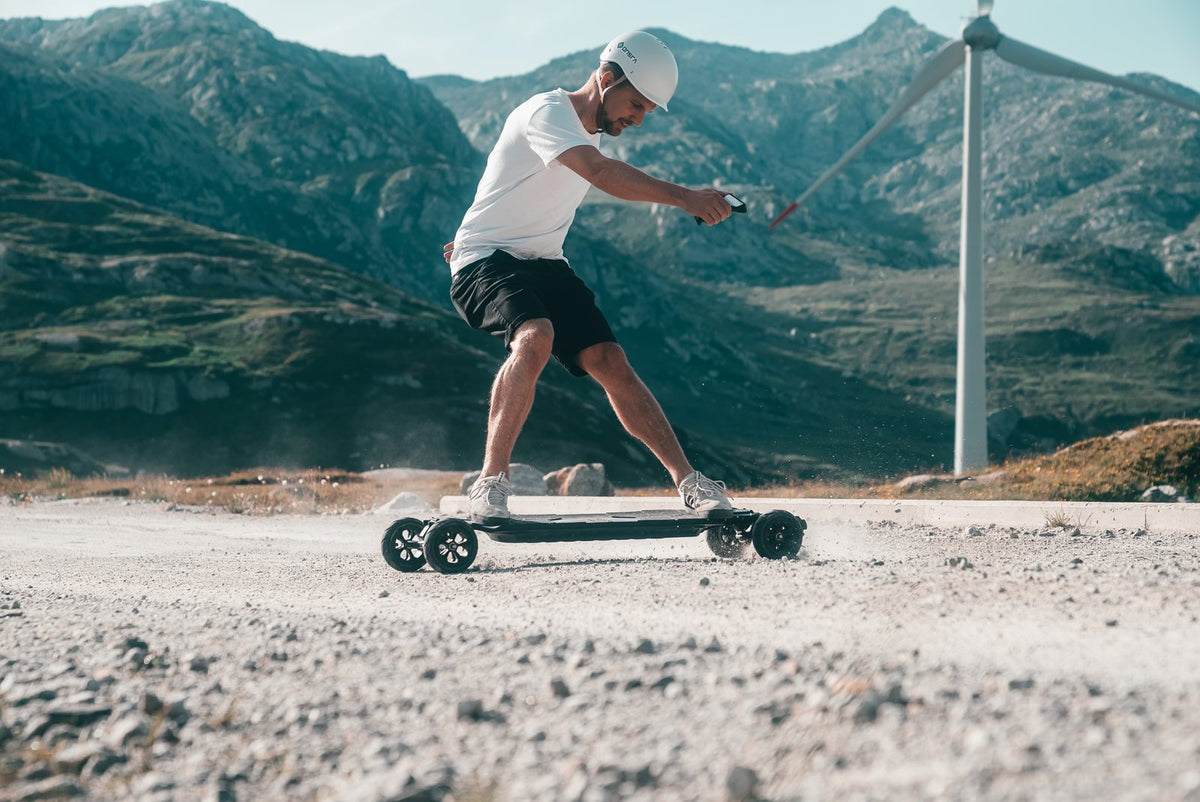

Private mountain gravel with the landowner's permission: this is the kind of riding the law allows. ONSRA photo, shot outside the UK. It is not a statement about where riding is legal in the UK.
Let's start with the honest part, because you deserve it before you spend money on a board. In the UK, electric skateboards are not legal on public roads, pavements or cycle lanes. That is not us being cautious, and it is not a matter of interpretation. It is what the Department for Transport says on GOV.UK, it is how the Road Traffic Act 1988 works, and it is how police forces enforce it. We link every source below.
Now the good part. An electric skateboard is not just a way to get from A to B on a city street. It is a carving machine, a trail toy and, with an all-terrain board, a brilliant way to explore land you have permission to ride. The law is just as clear about that: riding on private land with the landowner's permission is legal. Farms, estates, large gardens, private car-free roads that are closed to the public, private off-road trails and private land in the hills and mountains: that is where these boards shine, and that is where we want you riding.
Summary (checked October 2026):
- What the law calls them: electric skateboards are "powered transporters" and count as motor vehicles under the Road Traffic Act 1988.
- Public roads: not legal in practice. A motor vehicle needs insurance, registration, tax, a licence and must meet construction standards, which the DfT says users "will find very difficult".
- Pavements and footpaths: not legal (Highway Act 1835 s.72; Road Traffic Act 1988 s.34).
- Cycle lanes and cycle tracks, bridleways, restricted byways: not legal (Road Traffic Act 1988 s.21 and s.34).
- E-scooter rental trials: cover approved rental e-scooters only. They do not cover e-skateboards or any privately owned device.
- Legal: private land with the permission of the landowner or occupier, where the public does not have access.
One note before we dig in: this article is general information based on official sources, not legal advice. If something here does not match your situation, ask your local police force or check GOV.UK directly.
Why an electric skateboard counts as a motor vehicle
The UK has no special legal category for electric skateboards. Instead, the Department for Transport groups them with e-scooters, Segways, hoverboards and electric unicycles under the label "powered transporters". Its powered transporters information sheet explains that, because these devices are motorised, "they fall within the legal definition of a 'motor vehicle'. Therefore the laws that apply to motor vehicles apply to powered transporters."
The definition comes from section 185 of the Road Traffic Act 1988: a motor vehicle is "a mechanically propelled vehicle intended or adapted for use on roads". The DfT guidance points to several High Court cases confirming that devices like Go-Peds, electric scooters and Segways fall within that definition. An electric skateboard is mechanically propelled in the same way, so the same rules apply.
Electrically assisted pedal cycles (EAPCs, the legal kind of e-bike) are the exception: they have their own rules and are not powered transporters. An electric skateboard has no pedals, so that route does not apply.
Public roads: why it is not legal in practice
In principle, any motor vehicle can use a public road if it meets every legal requirement. The DfT lists them: insurance, conformity with technical standards, vehicle tax, registration and licensing, driver testing and licensing, and the right safety equipment. Then it adds the key sentence: "it is likely that they will find it very difficult to comply with all of these requirements, meaning that it would be a criminal offence to use them on the road."
In real life, no insurer offers standard motor insurance for an electric skateboard, and boards are not registered vehicles. So riding one on a public road means, at the very least, riding without insurance. Transport for London's e-scooter page spells out what that can cost for powered transporters: a fixed penalty of £300 and six points on your driving licence for having no insurance.

Off-road riding with the BLACK Carve 3 PRO, the previous generation of the BLACK Carve. Filmed off-road, outside the UK.
Pavements, footpaths, cycle lanes and bridleways
Away from the road, the rules get even simpler, because these spaces are reserved for people on foot, on bikes or on horses:
- Pavements. Section 72 of the Highway Act 1835 makes it an offence to ride on the footway. The DfT notes that this applies to almost all vehicles, with exceptions only for mobility scooters and wheelchairs.
- Public footpaths, bridleways and restricted byways. Section 34 of the Road Traffic Act 1988 makes it an offence to drive a mechanically propelled vehicle on them without lawful authority.
- Cycle lanes and cycle tracks. The DfT says powered transporters are prohibited from cycle tracks, cycle lanes on roads and other spaces for pedal cycles only, under section 21 of the Road Traffic Act 1988.
Section 34 matters for off-road riders too. It also covers driving "on to or upon any common land, moorland or land of any other description" that is not part of a road, without lawful authority. In plain English: open countryside, commons and moorland are not a free-for-all just because there are no cars. The permission of the landowner is what makes off-road riding legal.

ONSRA photo, shot outside the UK. It is not a statement about where riding is legal in the UK.
The e-scooter trials do not cover electric skateboards
The UK's e-scooter trials confuse a lot of people. Since 2020, the government has allowed approved rental e-scooters on roads and in cycle lanes in trial areas such as London (participating boroughs), Bristol, Birmingham, Liverpool, Cambridge and Oxford. The DfT's rental e-scooter guidance (last updated July 2026) sets the rules: rental only, a maximum speed of 15.5 mph, a driving licence with category Q entitlement, and insurance provided by the operator.
None of that applies to an electric skateboard. The powered transporters page says it directly: "Trials are for approved rental e-scooters only. The rules for private e-scooters and other powered transporters have not changed." GOV.UK's e-scooter rules page adds that you can only ride a privately owned e-scooter "on private land with the permission of the landowner". Electric skateboards follow the same powered transporter rules, so the trials do not change anything for them.
What the police can do
Riding a powered transporter where it is not allowed is a criminal offence. According to the DfT, penalties range from fines and penalty points to disqualification from driving, and riding dangerously or under the influence of drink or drugs can lead to more serious charges. GOV.UK also warns that a device used illegally can be seized by the police.
Northern Ireland has its own road traffic legislation, but the outcome is the same. The Police Service of Northern Ireland says devices like e-scooters and go-peds "do not generally comply with construction and use legislation and vehicle standards so are therefore, restricted to off-road use only", and lists the registration, insurance, licensing and equipment that road use would require.

Open private ground: room to carve, nobody else around. ONSRA photo, shot outside the UK. It is not a statement about where riding is legal in the UK.
Where you CAN ride: private land, with permission
This is the bit that gets lost in the headlines. The DfT is explicit: "It is legal to use a powered transporter on private land with the permission of the land owner." And: "There are no statutory restrictions on the use of powered transporters on private land which is not accessible to the public. The permission of the owner and/or occupier of the land will be required however."
The UK has a huge amount of private land, and an all-terrain board turns much of it into a playground:
- Your own land. A long drive, a yard, a paddock or a large garden.
- Farms and estates. Gravel farm tracks, grass fields after harvest and estate roads, with the owner's permission.
- Private car-free roads. Private roads that are closed to the public and to traffic, with the owner's permission.
- Private off-road trails and hills. Private trail networks, quarries, hill farms and mountain estates in Wales, Scotland and northern England where the landowner allows riding.
- Venues that welcome e-boards. Private tracks, bike parks and event sites that allow electric skateboards. Always ask first.
One important detail: the DfT says some of the same restrictions apply to places that are privately owned but accessible to the public, such as car parks, public squares, privately owned roads that the public uses, industrial estates and university campuses. So "private" is not enough on its own. The land should be closed to the public, and you need the landowner's or occupier's permission. Get it in writing if you can.

Riding the VELAR on mountain peaks. Filmed off-road in the mountains, outside the UK; not a statement about where riding is legal in the UK.
National parks, commons and public rights of way
Many riders hope the countryside is a loophole: "It's not a road, it's a hillside." Unfortunately, being away from cars does not make land open to motorised boards. Public footpaths, bridleways and restricted byways are off limits under section 34, and the same section covers commons and moorland without lawful authority. National parks in the UK are mostly made up of private farms and estates, so the rule is the same there: find the landowner and ask. Some estates and farms are happy to say yes, especially for a small group riding responsibly.

ONSRA photo, shot outside the UK. It is not a statement about where riding is legal in the UK.
Quick list: where it is NOT allowed
- Public roads and streets anywhere in the UK
- Pavements and pedestrian areas
- Cycle lanes and cycle tracks, painted or segregated
- Public footpaths, bridleways and restricted byways
- Public parks and other public spaces
- Private places that the public can access, such as supermarket car parks, campuses and industrial estates
- Commons, moorland and other land without the landowner's permission
Which board for private land and off-road estates?
If you will mostly ride on gravel tracks, grass, farm roads and hill estates, an all-terrain board with pneumatic tyres is the obvious choice. Our Challenger 2.0 All Terrain is the light kicktail option. The VELAR 2.0 S with 200 mm tyres and suspension trucks is the one for rough ground and long days. The BLACK Carve 4 AT sits in between for riders who love a longboard carve. If your private land is wet as often as most of the UK, our waterproof buying guide covers sealing, IP ratings and drying your board.

ONSRA Challenger 2.0 All Terrain
From US$1,450 (prices shown in US dollars)
Kicktail, 150 mm pneumatic tyres, around 10 kg. Easy to throw in the boot and carry across a field.

ONSRA VELAR 2.0 S
From US$2,990 (prices shown in US dollars)
200 mm pneumatic tyres, suspension trucks, 1036 Wh battery. Our pick for rough private trails and hill estates.

ONSRA photo, shot outside the UK. It is not a statement about where riding is legal in the UK.
FAQ
Are electric skateboards legal in the UK?
Only on private land with the permission of the landowner or occupier, where the public does not have access. The Department for Transport classes electric skateboards as powered transporters, which are motor vehicles, so they cannot legally be used on public roads, pavements or cycle lanes.
Can I ride an electric skateboard on the pavement in the UK?
No. Section 72 of the Highway Act 1835 makes riding on the footway an offence, and the DfT confirms it applies to powered transporters.
Can I ride an electric skateboard in a cycle lane?
No. The DfT says powered transporters are prohibited from cycle tracks, cycle lanes on roads and other spaces for pedal cycles only.
Do the UK e-scooter trials include electric skateboards?
No. The trials cover approved rental e-scooters only. The rules for private e-scooters and other powered transporters, including electric skateboards, have not changed.
What happens if I ride an electric skateboard on the road?
It is a criminal offence. You could face a fine and penalty points, for example a £300 fixed penalty and six points for no insurance according to Transport for London, and the board could be seized.
Can I ride on a private road?
Only if the road is not accessible to the public and you have the owner's permission. The DfT says some restrictions still apply to privately owned roads that the public can use.
Can I ride off-road in the countryside or mountains?
Yes, on private land with the landowner's permission. Without lawful authority, section 34 of the Road Traffic Act 1988 makes it an offence to drive a mechanically propelled vehicle on common land, moorland, footpaths, bridleways and restricted byways.
Official sources
- GOV.UK (Department for Transport): Powered transporters information sheet
- legislation.gov.uk: Road Traffic Act 1988, section 185 (meaning of "motor vehicle")
- legislation.gov.uk: Highway Act 1835, section 72 (riding on footways)
- legislation.gov.uk: Road Traffic Act 1988, section 34 (driving elsewhere than on roads)
- legislation.gov.uk: Road Traffic Act 1988, section 21 (cycle tracks)
- GOV.UK (Department for Transport): Using a rental e-scooter (trial guidance)
- GOV.UK: Riding an electric scooter: the rules
- Transport for London: E-scooters
- Police Service of Northern Ireland: E-scooter, scrambler and quad safety
Checked October 2026. Rules change, and this article is general information, not legal advice. If in doubt, check the current rules on GOV.UK or ask your local police force.

Electric Skateboard Laws in Canada: Where You Can Ride, Province by Province
Electric Skateboard Laws in Canada: Where You Can Ride, Province by Province